‘Building’ With Potato ‘StarCrete’ Bricks on Earth and Mars
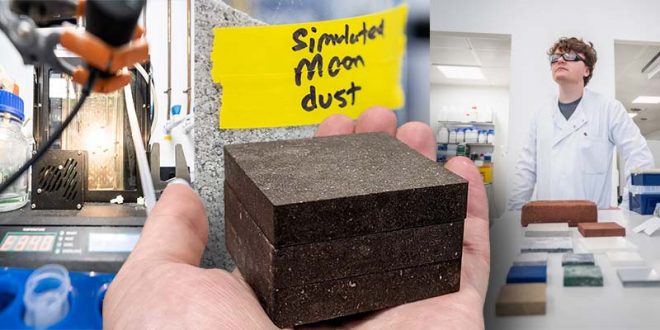
Scientists from the University of Manchester have developed a novel substance called ‘StarCrete’. The material, which is twice as powerful as regular concrete and is ideal for use in building projects in extraterrestrial settings, was developed by scientists using potato starch, salt, and replicated Martian dirt.
The study team showed how common potato starch can function as a binder when combined with synthetic Martian dust to create a substance resembling concrete in a paper published in the journal Open Engineering. ‘StarCrete’ measured 72 Megapascals (MPa), more than twice as powerful as the 32 MPa found in typical concrete. Even more powerful ‘StarCrete’ created from lunar dust measured over 91 Mpa.
According to the team’s calculations, a 25 kg bag of dried potatoes (chips) contains enough starch to make nearly half a tonne of ‘StarCrete’ or more than 213 bricks’ worth of material. In contrast, it takes about 7,500 blocks to construct a three-bedroom home. They also found that magnesium chloride, a ubiquitous salt that can be obtained from the Martian soil or astronaut tears, greatly increased the product’s strength.
The project’s subsequent phases will involve bringing ‘StarCrete’ from the lab to applications. DeakinBio, a start-up organization founded by Dr. Aled Roberts, Research Fellow at the Future Biomanufacturing Research Hub, The University of Manchester and lead researcher for this project and his crew, is looking into methods to make the product better so that it can be used on Earth as well.
If used on Earth, ‘StarCrete’ might provide a more environmentally friendly concrete substitute. Due to the extremely high temperatures and energy requirements involved in making cement and concrete, they contribute about 8% of the world’s CO2 emissions.
On the other hand, ‘StarCrete’ can be prepared in a regular oven or microwave at typical “home baking” temps, resulting in lower manufacturing energy costs.