

Manufacturing Inefficiencies Remain Key Driver Of Food Waste Ahead Of Stop Food Waste Day
Food waste generated during manufacturing remains a significant challenge for processors, with operational inefficiencies, inspection errors and manual processes contributing to unnecessary product loss and rising costs across the value chain.
Ahead of Stop Food Waste Day on 29 April 2026, Phil Brown, an inspection and food safety specialist at Fortress Technology, highlighted the role of production-stage decision-making in reducing avoidable waste.
“Waste in food manufacturing extends to the entire lifecycle of the product. This comprises removing potentially contaminated or out of tolerance products from production lines before they reach the market,” Brown said. “Additionally, food manufacturers need to consider every interconnected factor. These can include the carbon and energy emissions that have gone into growing, harvesting and making every product, to water wastage and labour costs.”
Globally, more than one-third of food produced is lost or wasted, with a notable share occurring during processing due to quality control rejections, inefficiencies and packaging issues. Within manufacturing environments, inspection performance and equipment configuration play a central role in determining how much product is unnecessarily discarded.
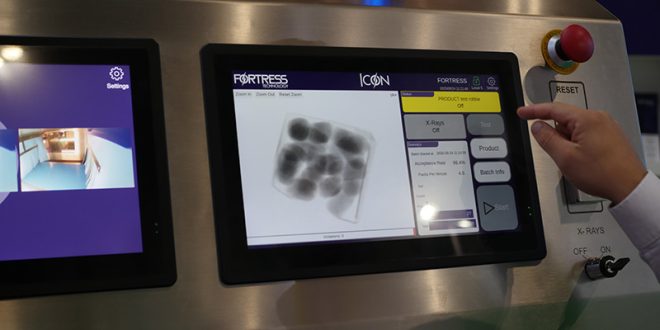
Upstream inspection strategies are increasingly being deployed to limit waste escalation. Detecting contaminants earlier in the process—at raw material intake or during initial processing—can prevent larger volumes of finished product from being rejected later in the line. According to Brown, “there is always value to be gained from implementing gravity, pipeline and conveyor metal detectors upstream as this makes it easier to detect and reject metal contaminants in their largest and less expensive forms.”
At the same time, false rejects—where compliant product is incorrectly flagged as contaminated—remain a persistent source of avoidable waste, particularly in high-moisture or conductive foods such as meat, dairy and ready meals. These product characteristics can interfere with detection systems, leading to conservative rejection thresholds.
“The technology selected is always dependent on the most prevalent food safety risks,” Brown added, noting that improving detection accuracy is critical to balancing compliance with yield preservation.
Beyond contaminant detection, overfilling and product giveaway also contribute to cumulative losses. Even marginal over-portioning across high-volume lines can result in significant material waste over time, reinforcing the need for precise weight control and real-time monitoring.
Digitalisation is emerging as a key enabler in this context. Connected inspection systems allow manufacturers to track reject rates, identify patterns and respond more quickly to inefficiencies across multiple lines. “Digital tools are increasingly critical for waste management,” Brown said.
Automation is also being applied to routine inspection processes. Manual testing of detection equipment, often required for compliance, can introduce variability and consume production time. Automated testing systems are being adopted to reduce human error and maintain continuous verification without interrupting operations.
While technology is a central component, Brown stressed that organisational factors remain equally important. “Every gram of food saved quite literally reinforces global food security and supports humanitarian objectives. The more united teams are in the effort to reduce good food waste, the more powerful our food industry becomes.”
As manufacturers face mounting pressure to improve efficiency, meet sustainability targets and reduce costs, the production stage is increasingly seen as a critical control point in tackling food waste at scale.