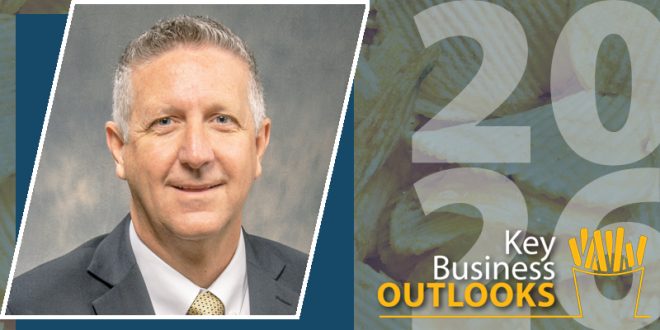


Key Business Outlooks 2026: Bjorn Thumas, Business Development Director at FAM STUMABO

Key Business Outlooks 2026 reflects the perspective of Bjorn Thumas, Business Development Director at FAM STUMABO, as structural pressures reshape how processors evaluate cutting and preparation technology. He discusses why workforce scarcity, energy costs, and multi-shift consistency have made operational simplicity and reliability decisive factors, how investment decisions are increasingly weighed between expansion and efficiency, and why proven, industrial-scale differentiation—rather than novelty alone—is defining the next phase of technology adoption in potato processing.
Looking back at 2025, which customer pressures proved structural rather than temporary, and how did they reshape your commercial or product strategy?
Several pressures that were initially viewed as temporary have clearly become part of the structural reality of food processing. Workforce scarcity, sustained energy costs, and the requirement to deliver consistent output across multiple shifts are now everyday constraints. Customers are far less tolerant of operational complexity and variability. This has further reinforced our strategic focus on solutions that simplify operations, reduce dependency on highly skilled operators, and deliver stable, repeatable results. Rather than reacting to short-term market signals, FAM STUMABO continues to prioritize reliability, ease of use, and measurable operational value.
As you plan for 2026, which market assumptions are you revising, and where do you see the greatest hesitation or uncertainty among your customers?
One assumption we are revisiting is the idea that investment behavior would simply revert to pre-2020 patterns.
While underlying demand fundamentals remain strong, customers are more cautious and selective. The most significant hesitation we observe is not about whether to invest, but where to allocate capital. Processors are carefully weighing capacity expansion against efficiency and automation, with a clear preference for investments that stabilize operations and protect margins in a volatile environment.
How do you expect investment behavior among processors to evolve in 2026, particularly regarding capacity expansion, efficiency upgrades, and automation?
Investment is expected to remain disciplined. Capacity expansion will continue in growth regions such as Asia and Latin America, while globally, the emphasis will be on efficiency-driven projects. Processors are prioritizing solutions that reduce dependency on operators, minimize downtime, and deliver consistent quality. Investments with a clear, short-term operational return are progressing most decisively.
Where did your strongest growth opportunities come from recently, and what did those projects reveal about changing customer priorities?
FAM STUMABO’s strongest growth opportunities have come from projects that combine product differentiation with strict requirements for consistency.
The recently launched SureTec 240P features the SureCut Unit (SCU), a unique concept, and has conquered the hearts of many operations/production managers.
In both chips and French fries, customers are seeking new shapes, textures, and formats, while maintaining tight quality tolerances. These projects show that innovation is only embraced when it can be delivered reliably, at scale, and without introducing additional operational risk. Customers increasingly value partners who can translate differentiation into an industrial reality.
How do you balance near-term customer demands with longer-term R&D investment, especially in a more cautious capital-spending environment?
Balancing near-term demands with long-term R&D requires constant prioritization. Customer feedback plays a central role in shaping our development roadmap. This approach ensures that longer-term investments remain closely aligned with real customer needs and deliver tangible value.
Which developments in 2025 most disrupted your planning or sales pipeline, and how did your organization adapt?
One of the most disruptive developments was the increased scrutiny customers placed on the gap between promised performance and real-world results. Decision-making cycles became longer, and validation processes more rigorous. In response, we intensified early technical dialogue, worked more closely with integrators, and invested more time up front to ensure seamless integration. This approach reduced downstream issues and increased customer confidence.
FAM STUMABO also strengthened its international presence with new facilities in Spain, Germany, and the US. The expansion reflects our continued investment in customer proximity and local service excellence, and, in North America, in establishing a direct presence. These developments significantly enhance our ability to respond quickly to customer needs and build closer, long-term relationships across key global markets.
Which external drivers—energy, labor availability, regulation, digitalization, or sustainability requirements—are most influencing equipment purchasing decisions today?
Labor availability and sustainability-related efficiency are currently the most influential drivers. Ongoing workforce scarcity pushes processors toward intuitive equipment that can be operated with less specialized skill. Sustainability is increasingly approached through operational efficiency – reducing waste, rework, and yield loss – rather than pursuing abstract targets. Digitalization supports these goals by delivering actionable insights and simplifying shop-floor decision-making.
From your perspective, which policy or regulatory developments would most support long-term technology investment in the potato processing sector?
Stable and predictable regulatory frameworks are the most supportive for long-term technology investment. Processors benefit from clear guidelines that enable confident planning rather than requiring constant adaptation. Policies that promote fair trade, reasonable energy frameworks, and innovation-friendly environments enable companies to focus on competitiveness, operational excellence, and continued technological advancement.
How do you see the relationship between promised technological performance and real-world operational results evolving, and where do customers now demand clearer proof of value?
Customers increasingly demand proof that technology delivers as promised in real production environments, with little tolerance for performance gaps caused by complexity or poor integration. Value is measured through tangible outcomes: stable throughput, reduced waste, consistent quality, and lower operational stress. Suppliers who can clearly demonstrate these results gain a strong competitive advantage.
FAM STUMABO locations feature on-site test labs, where our specialists assist customers in selecting the best machines for their operations through demonstrations and tests to validate feasibility and optimize the product.
What is your five-year vision for processing technology in the potato sector, and how does your company plan to remain relevant as customer expectations mature?
Over the next five years, FAM STUMABO anticipates continued growth in the sector alongside rising expectations for consistency, efficiency, and differentiation. Technology will evolve incrementally, becoming more integrated, robust, and easier to operate. Our relevance will depend on close collaboration with our customers, continuous improvement in machines and cutting tools, and the delivery of innovation without compromising operational reliability.
Innovation remains at the heart of everything we do and the foundation on which we build. That focus goes hand in hand with absolute supplier reliability. By expanding production capacity and strengthening our quality assurance processes, FAM STUMABO secures continuity, consistency, and scale. This allows us to grow alongside our customers and respond decisively to their evolving volumes, standards, and ambitions.