To Efficiently Integrate Every Step of the Potato Cleaning Into One Processing Line
Washing, removing soil, stones, and foreign bodies such
as metal, wood, or plastics from potatoes significantly boost food safety,
however it is not only washing but also optical sorting and checking, that
prevents impurities from contaminating the product.
It is important for any equipment that can separate crop from the soil, stones,
and debris, to be designed to handle the cultivars gently, to ensure product
quality. By using advanced and automated equipment, these processes can be
carried out much quicker and more effectively than before, ensuring the process
is efficient and productive, while maintaining the integrity, and ultimately
the value of the crop.
Joost Posthumius, sales manager at Allround Vegetable Processing, exclusively
talked with www.potatobusiness.com editors about his company’s solutions
Knowing that your company’s experts are continuously developing new,
sustainable technologies for these processes, can you tell us what are your
most advanced standalone and turnkey solutions for this “Pre-cleaning, Washing,
Destoning” triad?
One of our turnkey solutions for washing and destoning is the PD washing
machine. In front of the PD there is an integrated destoner, which cleans your
produce of clods and stones. This combination is perfect because there aren’t
any stones or clods in the PD, the PD is far more efficient. Also, the PD is
equipped with a stainless steel drum that won’t rust.
For pre-soaking, you can use our wet hopper. The wet hopper is used in the same
way as a normal hopper but has the ability to pre-clean produce. The product
falls in the water, where the sticky soil makes it heavier. With air coming
from the bottom of the machine, bubbles are created which has a cleaning
effect. Because of the reduced weight, the product comes up and is taken out by
a web belt.
Destoning can be done with our destoners. The destoners are designed to remove
dirt and stones from the processing line. When you place a destoner in front of
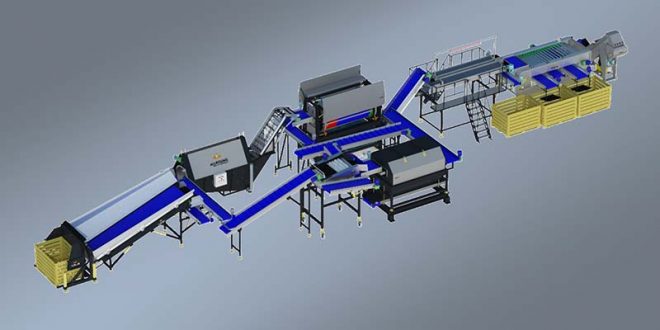
a washing machine it creates an even better cleaning result. Our AIPL (Allround
integrated processing line) is our turnkey solution for pre-cleaning, washing,
and destoning. With these lines, you can process multiple products. Our AIPL’s
are easily extendable and can be adjusted to particular needs. In the AIPL’s
you are capable of receiving, grading, washing, polishing, cleaning,
inspecting, and weighing. With the AIPL’s you can have every process of the
product be integrated into one processing line.
How does your equipment minimize product waste and reduce bruising and
damage?
Our machines are customized to the kind of produce it has to process. Carrots
for instance are not very vulnerable and they can work with ‘rougher’ machines
than onions. We also make sure that in our processing lines drop heights are
reduced to a minimum, so the drop won’t damage the product. Our equipment
minimizes product waste by handling the product very carefully.
What are some of the most common demands you get from clients regarding
capacities, speed, and accuracy?
The most common demands from clients are onion, potato, and carrot lines with a
capacity range from 10 to 50 tons per hour. We rarely get any special demands
regarding the speed of the machines. Our machines have to be capable to do the
requested amount of tons per hour. The demand we get regarding accuracy often
lays between 90 and 98%. This depends on the capacity of the processing line.
Why should we consider pre-cleaning so important?
Pre-cleaning is important because when you pre-clean your produce it will be
ready for packaging or the next processing steps like cutting, peeling, etc.
When you pre-clean produce most dirt will be washed off. When you pre-clean
before the washing machine, the washing machine is capable to wash the produce
better. This results in perfectly washed produce, which will look better in the
stores. For a finishing touch, you can also use our polisher.
Automation and reduced labor requirements are other two important aspects.
How do you incorporate the newer technologies into your equipment?
We’ve made lines that are almost completely automatic. With these machines, the
labor requirements are reduced to a minimum. For example, we have the box
stacker, which can stack boxes automatically up to three boxes in height. The
boxes are then transported to a place where a forklift can take them away. By
using the box stacker you provide a logistic advantage by reducing forklift
movements. Another example is our storage hopper. By storing product in a
storage hopper instead of boxes, you can dramatically reduce your forklift
movements.
How do you see the future advancements of these types of equipment and the
market demand for them?
With more and more advancements and bigger companies investing in the farming
industry there will be a bright future I think. Our technology makes sure that
farmers, retailers, and investors can handle more produce. The demand for
bigger and faster vegetable processing lines will go up. Vegetable processing
machines will have to be bigger and faster to supply that demand.