

International Day of Potato: How Innovation Is Redefining Potato Processing
By Twan van den Berg, Group Solution Specialist Manager – Processing, TNA Solutions
Few crops have left a mark on global cuisine quite like the potato. Grown in over 100 countries and with approximately 380 million tonnes consumed in 2024, its appeal lies not just in its nutritional profile and affordability, but in its versatility across cultures, cuisines, and formats. From golden fries to delicately flavoured crisps, the potato continues to be transformed into some of the most popular food products worldwide. And with global consumption anticipated to rise to 398 million tonnes by 2035, that is showing no signs of slowing.
Testament to the humble potato’s enduring popularity is the fact that the Food and Agriculture Organization of the United Nations (FAO) has designated May 30th as “International Day of the Potato”. For 2025, the theme is “Shaping history, feeding the future.” — a fitting reflection of the potato’s evolving role within the food industry.
But it’s not just the role of potatoes in the global diet that is evolving. The food industry itself is facing rapid change. From shifting consumer habits to rising production costs and increasingly strict regulations, success now depends as much on innovation as it does on tradition. The ability to deliver high-quality, low-waste, and consistent potato products at scale is becoming a defining capability for food processing companies worldwide. The key? Smarter systems, more flexible lines, and tighter control of every stage of the process.
Cutting into the future
At the core of most potato snack or fry products lies a seemingly simple process: cutting. Yet this fundamental step has been revolutionised in recent years through the rise of hydro-cutting technology. Unlike traditional mechanical systems that rely on physical blades and variable alignment, hydro-cutting uses a high-pressure water stream to propel potatoes into an alignment tube and through a fixed knife block. This ensures each potato is cut lengthwise with precision and consistency.
Alongside uniformity in size and shape, this technology ensures smoother surfaces with less micro-serration. This matters because rougher surfaces tend to absorb more oil during frying. With hydro-cutting, processors can reduce oil uptake in their final products, creating a crispier, healthier product while also reducing overall oil consumption.
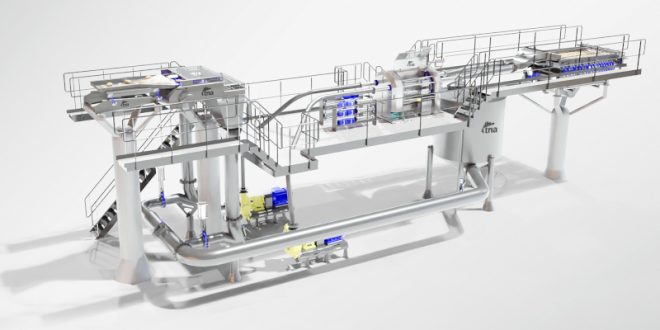
For processors dealing in high volumes, the performance benefits extend further. Systems like the tna conti-cut® are engineered for 24/7 uptime, featuring automatic switchers that cycle in new alignment tubes and knives without pausing production. It’s this combination of quality, efficiency, and reliability that allows manufacturers to keep up with demand while maintaining brand consistency.
Oil integrity: the underestimated driver of quality
Frying may be one of the oldest processing methods in the industry, but its technology never stood still. In today’s market, the pressure is on processors to improve both product quality and operational efficiency — and oil management sits at the heart of both.
Maintaining high oil quality throughout continuous frying operations is essential. It affects everything from taste and texture to product shelf life and food safety. Continuous filtration systems have become standard in modern lines, removing crumbs and particulate matter before they degrade and contaminate the oil.
What’s changing is how processors monitor the oil itself. Intelligent oil management tools can now track key indicators such as free fatty acids (FFA), peroxide value, and overall oil turnover in real-time. These insights give operators the information they need to make proactive adjustments, whether that means partial replenishment or adjusting heat settings to avoid oil breakdown. The result is less waste, more consistent product outcomes, and easier regulatory compliance.
Different oil types bring different handling requirements. For instance, palm oil’s high stability makes it well-suited for frying, but it’s more costly compared to palm oil (<OPEX) and requires temperature management to prevent solidification in the line prior to start-up and shut down. Less stable oils like sunflower oil are more affordable, but degrade more quickly under heat, requiring tighter filtration and turnover schedules. The ability to handle this complexity through integrated control systems is giving processors a competitive edge.
Staying one step ahead
Beyond oil and hydro cutting, perhaps the most critical shift in modern potato processing is the drive for line-wide flexibility. Consumer tastes are evolving fast, and the ability for food processing companies to respond quickly without overhauling production infrastructure is no longer optional.
In markets like France, this agility has proven essential. The country’s frozen potato product market has reportedly grown by 25% since 2019, driven primarily by younger, convenience-focused consumers. As this trend accelerates, processors must be prepared to pivot product lines quickly and efficiently.
That’s where complete line solutions make a difference. By integrating functions like washing, slicing, frying, seasoning, and packaging into a single coordinated system, manufacturers can reduce waste, simplify maintenance, and accelerate product changeovers. It also enables data-driven insights from the entire process, allowing teams to continually refine performance and output.
Smart line design is especially vital when managing ingredient variability. Potato size, dry matter content, and regional variety all influence the success of a given cut or fry. Advanced systems can adapt parameters dynamically, ensuring consistency even with natural fluctuations in raw material. This is particularly valuable for global brands sourcing potatoes across multiple regions.
Honouring a legacy by investing in the future
The potato has earned its place as one of the world’s most important staple foods. But preserving that role in today’s market takes more than tradition. It takes investment in technologies that improve yield, protect resources, and enable consistent, scalable performance. For food manufacturers looking to futureproof their operations, the innovations driving potato line efficiency today are not just nice-to-haves. They’re becoming the new baseline. And with global demand continuing to rise, smart, flexible, high-performance processing systems will be what allows the next generation of potato products to deliver on both heritage and innovation.