

Potato Storage Climate Control: All Tools Available When Needed
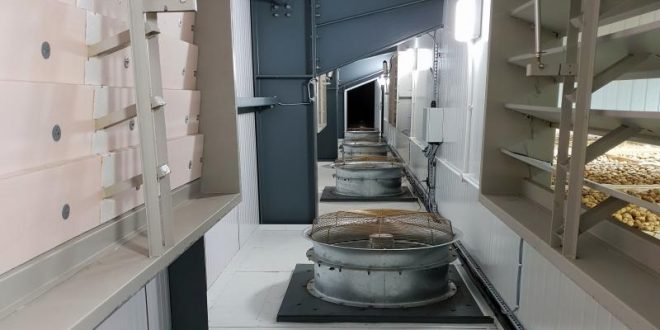
The two crucial environmental factors involved in properly storing cultivars are temperature and humidity. Appropriate and unrestricted air movement is also necessary to maintain constant temperature and humidity throughout the tubers’ storage pile and to prevent excessive shrinkage from moisture loss and decay.
Potato storage is a key element of modern-day potato production, looking to fulfill the demands of many markets. It can be practiced successfully but it must also be acknowledged that storage poses a risk. Its success depends on how well that risk is managed and, ultimately, whether the customer for the crop in question is delivered the quality for which they are prepared to pay.
The first thing a storage owner needs for the optimal stock is a well-insulated storage building. All efforts of maintaining the climate optimal are meaningless when the building doesn’t keep heat/cold and moisture outside. Number two on the “to-do list” is the knowledge about how to store for the storage operator. This means knowledge about how potatoes behave in storage and about how (moist) air behaves. And that knowledge is necessary both for the state of the art storage and in less-than-ideal situations.
Therefore, having good control of the store is critical in the sense that it should only incur cost when delivering a benefit. This control extends to such aspects as servicing and calibrating the store equipment before use, loading the store correctly, operating the ventilation system and ensuring the airflow is optimized, minimizing air leakage, and so on. Store management is a complex process and there are multiple points at which problems and inefficiencies can occur and jeopardize the prospect of success.
Good store management should ensure crop temperatures are as uniform as possible to minimize the risk of condensation. Sensors, therefore, need to be sufficiently accurate to measure differences as small as 0.5 degrees Celsius.
Ventilation is a critical process in storage, as the movement of air through the potatoes is the primary means of regulating the crop condition by drying, cooling, heating, humidifying, or adding chemical treatments. Specific strategies are needed for key processes, such as drying and initial pull-down, to holding temperature, and for the use of refrigeration, which are discussed in the following sections.
In the ideal situation, the store owners need ventilation, refrigeration, and heating to have all tools available when needed.
You can read the rest of this article in your complimentary e-copy of Issue 1 of Potato Business Digital 2022 magazine, which you can access by clicking here.