

Costs Down, Quality Up

Doing it more efficiently is the creed of most potato processors and this applies as much to the blanching stage as it does to any other in the production process. Andre Erasmus takes a look at some of the latest developments.
Depending on what part of the potato processing industry you are in, the type of blancher used could differ. The potato snack market would traditionally use a lot of drum blanching systems. The French fry industry prefers screw blanchers while mashed potato producers use belt blanchers.
Chris Imdieke, mechanical engineer at Gem Equipment of Oregon, said belt blanchers use water to leach sugars, gelatinise starch, kill enzymes, and improve surface texture of cut fries.
“If you have ever compared homemade fries to those at your favourite restaurant, you can see why blanching is important. Consumers expect golden brown French fries regardless of the sugar content of the potatoes from which they originate.”
Imdieke said belt blanchers are big machines, with a typical French fry blancher-sized between eight and twelve feet wide and 50 to 150 feet long.
“Most Gem Equipment belt blanchers are bi-mode, that is, they can operate in either immersion or deluge mode. In deluge, the water level in the blancher tank is below the belt and overhead spray pipes ‘deluge’ water over the product. In immersion, the water level is maintained over the belt, ‘immersing’ the product.”
Resources: Water
Imdieke said blanching potatoes uses two resources: water and energy.
Water use can be separated into two categories: system volume and makeup water. “Gem belt blanchers are designed with water volume in mind. The blancher tank has a sloped flume down the centreline that collects return water and returns it to the pumps.
“This allows adequate suction pressure at the recirculation pumps without filling the entire blancher tank. It also allows the tank under the belt to be very shallow, minimising volume during immersion mode.”
Imdieke said system volume can also be minimised by good blancher sizing and zoning. “Designing a blancher based on peak line flow, lowest product depth, and highest sugar content may lead to an oversized machine with excess water volume.
“If immersion blanching is only needed for one minute out of a 15 minute total blanch, the first zone tank can be very short, separated from the others and operated at a higher water level. This allows the remaining zones to run at the lower, deluge water level or possibly without water.
“While operating in immersion mode, controlling water depth is important. Depending on the blancher, every extra inch of water depth is about 600 extra gallons in the system.” He added that, in some older systems, the water depth is determined by the suction pressure required to prevent pump cavitation.
In modern systems, the pump suction piping is carefully designed based on water temperature, factory elevation, and pump suction head requirements. With the use of pressure sensors installed in each zone, the water levels can be set and controlled to match product depth without cavitating the recirculation pumps.
As the water is recirculated through the product, Imdieke said, starch and sugar concentrations build. To maintain acceptable levels in the recirculated water, fresh makeup water is added to the system. Many blanchers still use an overflow system for makeup. An unregulated flow of fresh water is simply added to the system and the excess pours to a gutter.
In regions where water usage is critical, however, many newer systems use a flow meter to monitor and control makeup water. Blancher water is regularly tested and used to set the makeup rate to each blancher zone. Reducing makeup water also leads to lower energy use.
Resources: Energy
Turning to energy, Imdieke said heating product and makeup water are the largest energy uses occuring in a blancher. “While not much can be done about the product, new systems have a heat recovery system, which utilises the hot, excess blancher water and a heat exchanger to preheat the makeup water.
“Water and energy use are becoming more important and influencing blancher design. New machines tend to be smaller, have more zones, and incorporate automated level, temperature, and makeup water controls for each zone.”
Meanwhile, the reduction of production costs, while enhancing product quality for mash, flake, and potato salad has become a major challenge for processors.
Now, even more so than previously, is this the case as the quest to be environmentally friendly is becoming more urgent.
In fact, Netherlands-based Aviko received European Union funding as long ago as 2006 to develop an environmentally-friendly blanching system for the potato processing industry that will save on water and energy costs.
The technology the Cosun-owned company came up with uses a closed system for the blanching process. The same water can be used repeatedly for blanching, instead of being replaced when it becomes saturated with sugars.
Aviko said it has succeeded in converting the sugars in the blanching water into other natural substances. This prevents the blanching water from becoming saturated with the sugars, which can therefore be used to continuously blanch them out of the potatoes.
“There is almost no need to replace the water, so less wastewater has to be discharged and less groundwater has to be abstracted,” the Dutch company said. “Moreover, less energy is required to bring the blanching water up to the necessary temperature.”
Similarly, Heat and Control maintain that blanching potato slices in hot water or washing them using cold water will ensure consistent chip quality when using different grades of potatoes, leading to a more efficient and cost-saving process.
Heat and Control’s versatile Potato Slice Injection Blancher uses multiple water inlet jets located across the width of the bottom of its pan to produce uniform blanching or washing.
Unlike blanchers that inject water from the sides, compressing slices into a tightly centered pack, Heat and Control’s bottom-up water injection process separates the slices, exposing more of their surfaces. Slices are spread across the discharge conveyor for thorough dewatering. Surface water and particles are removed by Heat and Control’s patented AirSweep vacuum/blow-off system to maintain clean, fuel-efficient fryer operation.
Innovations towards optimisation
Then there is ABCO’s well-established commitment to research and development which has lead the way in developing energy and water efficient blanching techniques for a very wide range of fruit and vegetables. Recently it seemed opportune to turn the spotlight of this expertise into the field of potato processing.
The result was an 18-month study by ABCO engineering staff working with Food Technology Scientists from Agriculture and Agri Food Canada on a new research project entitled: Study of Processing Parameters for High Quality Dried and Frozen Potato Products.
In the first phase of this study, samples of potato mash were produced by varying the processing parameters. And with whole against sliced potatoes and with the Heat/Hold steam cook system being ranged against a three-step water cook, ABCO and Agri Food Canada found that descriptive sensory analysis (DCA) and instrument analysis showed the Heat/Hold potatoes were lighter, brighter and more yellow than water-cooked potatoes.
In uniformity of colour, Heat/Hold-cooked mash was more uniform than the water-cooked mash.
Foods blanched in ABCO L-series Blanchers retain more nutrients and have enhanced colour and flavour, says the company. And this is achieved with reduced effluent levels and lower production costs. “Food processors on four continents now enjoy the benefits of this award-winning blancher technology.
“At ABCO we believe our success is directly related to the effort we put into collaborative research ventures, and to how well we can respond to the unique needs of each of our customers.”
Maintenance Optimisation
Another Netherlands-based company, BMA Nederland BV, picks up on yet a further aspect of being efficient – ease of maintenance.
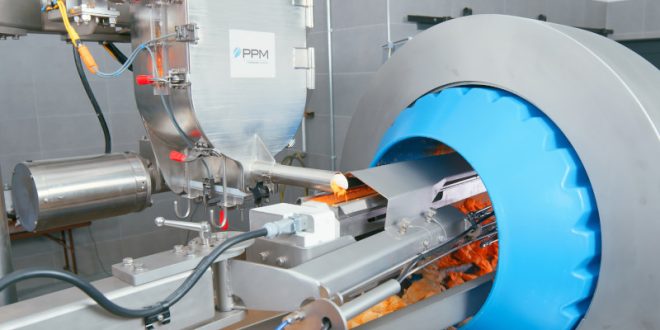
And they say their horizontal screw blancher with an independently driven Ferris wheel is maintenance-free machine with a high level of water circulation boasts problem-free transport of product at a constant and homogenous water temperature.
“Due to the rising energy costs and stricter regulations on emissions, environmental issues are getting more and more important for industrial companies worldwide,” said a BMA spokesman, adding that the company has developed different solutions for existing and new equipment to reduce the energy consumption.
An example is the steam condensate system BMA has marketed for some years already. With companies in potato processing looking for ways to optimise the entire energy balance of their existing plants, concrete measures to lower the energy consumption in one or more process steps need to be considered and implemented.
As a reaction to this demand, BMA has developed and standardised a calculation model which can be used to simulate the heat consumption of complete processing lines or individual sections.
The calculation model has been developed for French fries factories, but it is also applicable for the ‘wet’ section of other potato processing factories such as plants for potato flakes, potato granules and potato specialties.
All-in-One
Key Technology’s tried-and-tested Turbo-Flo Blancher is still regarded as a revolution in blanching, cooking, and pasteurising technology. Its efficient heat transfer increases throughout, reducing space requirements, while faster processing improves nutrient retention, taste, and appearance.
The Turbo-Flo reduces operating costs, increases profits, and reduces bacteria counts, says the Walla Walla-based company.
Its circulation method improves nutrient retention and colour, and there is the added bonus of increased efficiency through the hydrostatic water seal which eliminates evaporation, the major cause of efficiency loss. More efficient heat transfer allows a smaller system with higher product output, requiring less floor space.
Add a lower waste water benefit in comparison to conventional blanching/cooking/pasteurising systems and optional clean-in-place systems to simplify cleaning and ensure sanitation, and the Turbo-Flo remains a worthy competitor in today’s market.