

A Continuous ‘Arms Race’ Between the Potato Plant and Late Blight
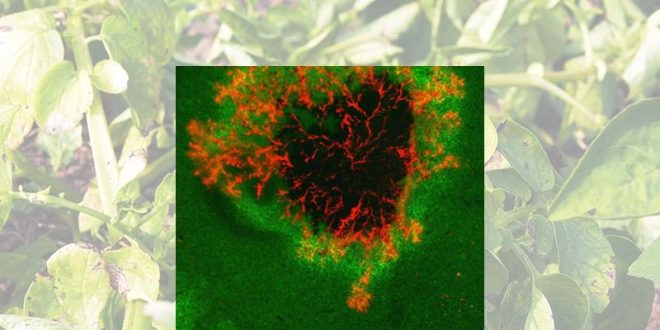
To combat potato late blight (Phytophthora infestans), massive quantities of crop protection agents are administered all over the world. To increase the sustainability of farming this crop, it is necessary to better understand the mechanisms underlying potato resistance.
Together with their colleagues in Tübingen and Norwich, researchers from Wageningen University & Research (WUR) have now made a significant advancement. The prestigious scientific publication Science has published their research.
“There is a continuous ‘arms race’ between the potato plant and Phytophthora,” says Vivianne Vleeshouwers, a plant scientist at WUR.
The plant fights back vehemently. Several defensive reactions are instantly triggered by the ‘fungus’ invasion (which is an oomycete or water mold), such as causing a controlled leaf death to halt the spread of the disease. However, by constantly evolving, Phytophthora infestans can get past these defenses.
Recognizing the Disease
To defend itself the first thing the plant has to do is recognize the pathogen.
“The plant has receptors for this, a kind of antenna. These bind tiny pieces of Phytophthora protein, which is the signal that something is wrong. This is when the defense responses kick in. So it is very important that the plant can detect the disease and has the right receptors in place to activate its defenses”, Vleeshouwers added.
These receptors might be found inside the cell or on the outside. Potato breeders make use of particular R genes (R stands for resistance), which encode receptors inside the cell. By cultivating plants with these R genes, they create resistant cultivars. The Phytophthora, however, consistently overcomes that resistance, which is the issue.
“Much less is known about the receptors on the outside, on the cell surface, the PRR receptors. These receptors drive more general immune responses”, Vleeshouwers says.
Plant breeders are currently focusing their attention on R genes, but more fundamental research is required to be able to benefit from less specific defense responses by the PRR.
To this end, WUR is cooperating with the University of Tübingen (Germany) and The Sainsbury Laboratory in Norwich (UK).
A Specific Type of PRR Receptor Called PERU
“We have been studying a specific type of PRR receptor called PERU. It binds a special piece of Phytophthora protein, Pep-13, which triggers the potato plant to recognize the disease. It was generally assumed that PRR receptors hardly change over time (a well-known example is the very stable receptor that recognizes bacteria flagella). But we found that PERU does exhibit dynamic evolution, and changes much faster than the more well-known PRR receptors. This is a new insight,” Vleeshouwers explained.
The findings of the study, according to co-researcher and project leader Thorsten Nürnberger of the Centre for Plant Molecular Biology (ZMBP) at the University of Tübingen, reveal that the evolution of immunological receptors on the cell surfaces of plants (the PRR receptors) has been far more complex than previously believed.
“There is not just one version of this receptor, but several variants that can recognize different binding molecules (the proteins of Phytophthora, ed.). This is a completely new finding,” Nürnberger explained.
Vleeshouwers mentioned that several wild potato species have variations of PERU.
“We have those plants in our collection and we can look back in time, as it were, to find out how they evolved. Once you understand their evolution, you can look for ways to translate that into applications. By selecting the right receptors, you can increase the plant’s resistance to the disease,” he declared.
By looking back in time, the researchers were able to trace the origins of the plant’s evolution: the Andes. The receptor is called PERU, which stands for Pep-13 Receptor Unit.
Sustainable Cultivation
Future potatoes will be sustainable thanks to this understanding of this class of receptors (and others that will come). This plant will have particular genes for resistance in addition to improved defenses in general.
“Before today, breeders focused on R genes. However, the resistance they offer is constantly being thwarted. By studying how wild potato species survive in an environment where they are constantly assailed by diseases, we can discover what mechanisms they use, and then introduce these mechanisms in our potato varieties”, Vleeshouwers concludes.