

The Art of Moving Potatoes

Transportation of potatoes is generally broken down into three stages: pre-process, during-process, and post-process. In pre-process, most customers transport potatoes by truck, typically in 40-foot enclosed vans. An alternate means is by rail car.
by Tudor Vintiloiu
Potatoes can be shipped loose in bulk or by placing them in 2,000 – 3,000-pound crates or totes. Transporting potatoes during-process and post-process stages is generally completed by a series of conveyors.
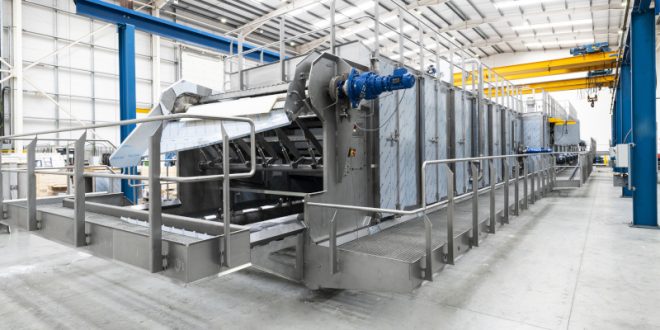
There are four primary conveyor systems used in potato processing: belt, flume, vibratory, and horizontal motion. Gentle handling is critically important in all stages of potato movement, affecting both yield (e.g., reducing bruising, slivering, breakage, finished product seasoning adherence), as well as finished product quality.
At the simplest level, conveyors are designed to connect critical process points within a potato processing plant, and the best conveyors do so with minimal damage to the product as they move product along as quickly as possible. Beyond that, conveying systems provide key internodal functions such as product accumulation or buffering, metering, overcoming changes in elevation, and dividing product flow to parallel unit operations.
The best conveying systems will provide these functions safely and sanitarily without exorbitant cost or maintenance time. Additionally, innovative conveyor systems providers will use LEAN design principles to reduce the total number of connection points and create the most efficient overall system for their clients.
Moving Potatoes
Potato processors would typically use as many types of conveyors as there are processing nodes in the product line, as each node will have its own unique requirement for their “bridging” conveyor. For example, dirt removal for raw products, de-oiling for fried products, seasoning in kitchen and at the weigher. Depending on how they are shipped (truck vs. rail), different means of unloading can be employed.
For example, when shipped loose in bulk, it is common to use a truck dumping system for unloading. In this case, the tractor and trailer are elevated to a 40-degree angle and the potatoes are poured out of the back of the truck. A series of conveyors are used to convey the potatoes into the plant where the potatoes are stored in large bins capable of holding 60,000–90,000 pounds of potatoes per bin.
Alternately, the potatoes can be put into crates for longer-term storage. If the potatoes are shipped in crates, a forklift is used to unload the truck and to bring the potatoes into the manufacturing plant.
You can read the rest of this article in your complimentary e-copy of the July/August Issue of Potato Processing International magazine, which you can access by clicking here.