

Matching Crops to Available Storage Conditions
The loading of potatoes in storage should be scheduled well in advance of harvest. It is critical to match crops to the storage available in terms of quality, likely storage periods, and market expectations so that management is effective and returns are maximized. The tuber crops must be lifted as free of damage, soil, stones, and haulm as possible.
The potato crop should be ventilated within an hour or two of entering the store to remove surface moisture from tubers and any remaining soil. Positive ventilation, such as that found in bulk stores or letterbox stores, will prevent condensation from forming on tubers in crops lifted in dry conditions. The airflow removes the warm air produced by the rapidly respiring crop, reducing the possibility of warmup-current condensing on the cooler potatoes above.
“Try to load stores within a week and an absolute maximum of 14 days. This ensures potatoes can be brought under optimal control and reduces the need to compromise on store management and, ultimately, crop quality. If loading within this timeframe is not normally achievable, you may benefit from dividing your store into two smaller sections. Temporary curtains can be used as a cost-effective option for this,” Sutton Bridge Crop Storage Research and AHDB specialists wrote in one of their guides.
Field random selection will detect rots, blemish disease, or slug damage, whereas warm storage (>20°C) of samples before harvest will detect potential rotting before loading. To avoid contamination, tater crops with rots or loads that have been rained on should be kept out of the bulk stack. Crops with 1-2% rots should be set aside, preferably in boxes, and continuously positively ventilated for 4-6 weeks, until any rots are mummified. Crops with rots of more than 2% should not be stored.
Primary Potato Processing in Different Production Environments
Potatoes are picked up by hand and carried in baskets or bags to bulk storage areas in potato production environments that lack or have limited mechanization. Tubers for trade, long-distance transport, and/or long-term storage or processing are picked up by hand and handled in bags in semi-mechanized settings where part of the operations is manual, such as planting and hoeing.
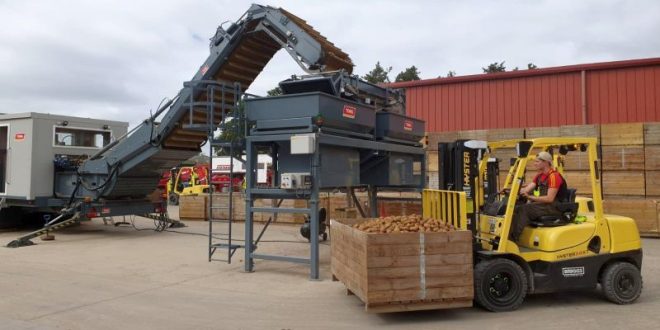
The spuds are stored in bulk or pallet boxes of 1 or 1.5 tons in fully mechanized potato settings. The fully automatic harvester either discharges the lifted tubers directly into a trailer that continuously follows the harvester or is equipped with a 3-15 ton hopper that is emptied into a trailer regularly.
The taters are transported to the store on a trailer with a capacity of 10-30 tons, where they are emptied into a feed hopper with the same capacity, which acts as a buffer. To remove soil and clods, the hopper exit is equipped with a set of cleaning fluted rollers with adjustable distances.
Where growers choose a first grading operation into two sizes (the grades are stored in separate compartments), a conveyor belt empties them into a telescopic bulk piler swinging. Its movements ensure that no soil cones form while depositing, obstructing an even flow of ventilation air and that the dropping height never exceeds a certain distance, e.g. one meter.
All machine speeds and angles are set manually or remotely, with the storekeeper using a handheld device. Some conveyor belts, particularly those used to fill boxes, have a nodding tip to reduce the drop height. When pallet boxes or large bags are used, the feed hopper empties into a conveyor belt connected to a box filler (dipping elevator).
You can read the rest of this article in your complimentary e-copy of Issue 3 of Potato Business Dossier 2022, which you can access by clicking here.