

Boosting the ROI Through a Partnership with a Turnkey System Provider

The process of designing and constructing a turnkey potato processing line is time-consuming and demanding, and the goal should always be to identify the best option for the client and his particular production process.
It is only possible to understand, discuss, and experience the issues and upcoming difficulties that customers are facing by visiting business owners and entrepreneurs at their location. Every machinery manufacturer needs to have a deep understanding of the daily workflow and production process to deliver a solution that not only performs as intended but also gives customers peace of mind, the ability to look ahead, and the ability to respond to new opportunities within their market.
“Our starting point is always the desired end product and result that the customer has in mind. This means that instead of starting at the beginning of a processing line, the first question should be: ‘What kind of end product(s) would you like to produce now and possibly in the future?’ With the answer to the above-mentioned question, our consultants actively start to form a solution whilst asking additional questions during the process. This slowly creates a clear picture for both the consultant as well as customer as to what it is they exactly want or need to successfully thrive in the future. After having brought to light all active and subconscious wishes of a customer, an offer can be drafted, based on their specific needs,” Marcelissen’s experts mentioned.
Engineering will begin when the order is submitted and every conceivable facet of a processing line is examined. In addition to aligning equipment, paying particular attention to where water and air connections are located, how far apart waste pumps should be placed to save energy, and whether or not easy cleaning options are provided in difficult-to-reach or customer-specific places are also prioritized. All of these guarantee that the final line will function well and adjust to the specific needs of the facility where it is installed.
In addition to having a thorough understanding of how various machines work mechanically and technically and how that affects the final product and outcome for the customer, one should also be knowledgeable about the actual products that the customer is processing to deliver precisely tailored processing lines.
“Take potatoes for example, after a hot summer potatoes are smaller than average and are therefore not ideal for making French fries, meaning that alternative products could be a way to sell the smaller products and still achieve the highest possible yield. On the other hand, when there is a very wet winter, the potatoes will often rot in the ground or show more defects than when being harvested after a relatively dry winter. This will result in more waste or oddly shaped products after being chipped. When you know wet winters can be common in certain areas, it gives the possibility to actively advise customers upfront concerning waste minimization and treatment to ensure the highest possible turnover, even when dealing with large amounts of waste in specific periods. […] It is important to have this deeper understanding of potatoes and what their life cycle looks like to know how to process and store these products as best as possible to obtain the highest quality end product,” Marcelissen’s engineers also added.
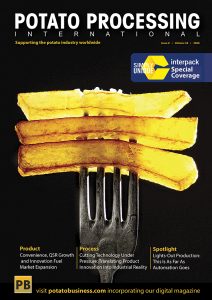
You can read the rest of this article in your complimentary e-copy of Issue 4 of Potato Business Digital 2023 magazine, which you can access by clicking here.