

Frying, Precisely: From Heat Transfer to Smart Oil Management
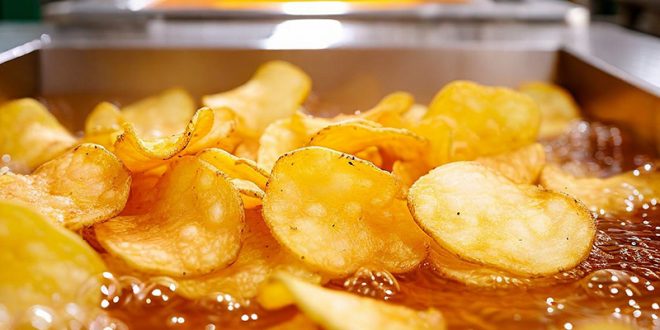
Industrial frying remains a carefully orchestrated exchange of heat and mass. When thin slices of potato, extruded pellets, or formed snacks hit hot oil, water at the surface flashes to steam, driving rapid dehydration while simultaneously creating a porous crust that becomes the scaffold for crispness.
Beneath that crust, starch gelatinizes, proteins denature, and the Maillard reaction begins to spin sugars and amino acids into the familiar golden color and roasted, nutty aromatics that define a well-fried chip.
For processors, the practical consequence is that thermal gradients and oil flow patterns matter as much as set-point temperature. Laminar, uniform oil flow reduces cold or hot spots across the belt; stable submergence prevents floaters from surfacing into cooler layers; and shaped entry zones manage the initial temperature drop as cold product loads the system. Equipment makers now treat these flow fields as a design variable, using baffles, multi-inlet circulation, and zone heating to keep the effective temperature seen by each piece within a tight band. The result is reduced variability in color and moisture and fewer over-fried pieces that can exceed acrylamide limits.
Oil Quality Is Process Quality
No matter how elegant the pan geometry, poor oil quality will write itself onto the product. Oxidation, hydrolysis, and polymerization progressively increase viscosity, darken color, and shift flavor, while accelerating oil pick-up and reducing shelf life. This is why processors track oil health with actionable metrics like total polar materials (TPM) and polymeric triglycerides. In European markets, discard points typically fall around the mid-twenties percent TPM, a practical limit adopted across foodservice and industrial frying operations.
A related concept—“oil turnover time”—defines how quickly the oil pool is renewed by make-up oil. High turnover continually refreshes the system, diluting degradation products and stabilizing flavor and color, while low turnover allows oxidative by-products to build. For processors running long campaigns, fryer volume, throughput, and filtration efficiency all intersect in determining oil age and, by extension, product consistency and cost.
You can read the rest of this article in your complimentary e-copy of Potato Processing International magazine, which you can access by clicking here.