

How Tomra 3A Saved a Spud Grower’s Time and Money
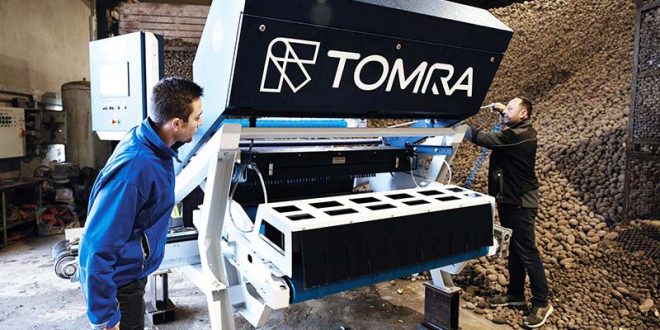
German business Johann Kraut Landwirtschaft’s investment in Tomra 3A paid off, according to a company’s recent press release, the optical sorting equipment substantially reducing the workload during harvest time, with cleaner potatoes and a higher daily yield.
“We used the Tomra 3A for the first time in the 2021 harvest season. The sorting capacity of the machine depends on the soil, among other things. With good conditions, it is possible to sort 40 tons per hour. Under demanding conditions, the high-capacity sorter saved us a great deal of time and was instrumental in helping us meet our tight schedules,” Andreas Kraut, junior manager at Johann Kraut Landwirtschaft, recently mentioned. “Also, the relatively large distance between the camera and the ejection process minimized the need for cleaning so that the sorter was continuously operational. During pauses between sorting, briefly removing dust from the lens protector with an air pistol, and wiping it over with a cloth in the evening, was completely sufficient for optimal sorting results.”
While the sorter has already proved to be a wise investment, Andreas believes it will become even more important to the business.
“We assume that the demand for potatoes will increase in the future, especially when more large-scale dining can take place once the pandemic has subsided,” Kraut added.
To consistently supply customers with a top-quality product, the cultivars are sorted after harvesting to remove stones and dirt, then stored with constant ventilation at 8 degrees Celsius. Prolonging storage time and preventing the potatoes from being damaged is possible only by first removing unwanted materials, such as dirt clods, stones, and other foreign objects, as well as green potatoes. For this purpose, the company has been using the Tomra 3A 1200 sorter (with a 1200mm-wide infeed conveyor) since 2021, making the work much easier. This machine is positioned at the entrance to the potato warehouse, where the Potatoes are sorted directly before going into storage.
The Tomra 3A is equipped with multi-spectral NIR (near-infrared) sensors. After the cultivars are fed to the machine by an integrated infeed belt, they are scanned in flight to sort out stones, dirt clods, and other foreign objects from the harvest in an intelligent, finger-based ejection process that minimizes loss of good produce. The potatoes continue their natural, free fall onto a trampoline belt that prevents them from being damaged.
“Manufacturers primarily prefer varieties that yield especially large Potatoes. Potatoes must contain a certain starch content to be suitable for French fry production. We mainly grow the Fontane variety here and supply a large regional buyer of Potatoes for French fry production,” Johann Kraut said.
German business Johann Kraut Landwirtschaft is a real potato specialist. The family-run 90-hectare (220-acre) at Bergkirchen, Bavaria, is now in the third generation and has been growing Potatoes for more than 50 years. For almost two decades now, the company has focused on supplying the food industry, mainly growing Potatoes to produce French Fries. Three different varieties of potato meet the special requirements of French Fries.