

Key Business Outlooks 2026: Alan Major, Chief Sales Officer at Urschel Laboratories
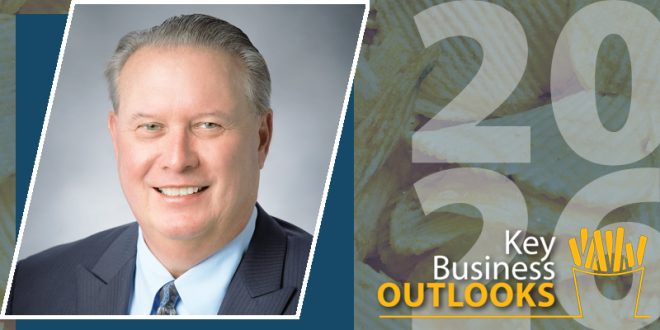
In this Key Business Outlooks 2026 interview, Alan Major, Chief Sales Officer at Urschel Laboratories, reflects on how tariff uncertainty, labor constraints, and investment caution shaped customer behavior in 2025—and what that means for processing technology decisions in the year ahead. He shares Urschel’s perspective on capital investment trends, automation priorities, and the balance between proven cutting performance and long-term R&D as processors demand clearer returns on equipment investments in an increasingly cost-sensitive environment.
Looking back at 2025, which customer pressures proved structural rather than temporary, and how did they reshape your commercial or product strategy?
We were pleased to see that customer demands remained unchanged, and there were no real additional structural processes that were not prevalent in the past. In 2026, Urschel will continue to look for and pursue customer needs as they arise with new product development.
As you plan for 2026, which market assumptions are you revising, and where do you see the greatest hesitation or uncertainty among your customers?
The uncertainty of business costs and climate due to tariffs was a primary concern when developing Urschel’s 2026 plan, as each of the tariffs have varied by size, location, and political situation within each country. While I always try to remain optimistic with most markets, Asia is an ongoing concern.
How do you expect investment behavior among processors to evolve in 2026, particularly regarding capacity expansion, efficiency upgrades, and automation?
I’m optimistic about Urschel’s increased investment in the U.S. market, Europe, and in general, with the Asian markets somewhat down overall. In 2025, Urschel expanded its product portfolio through acquiring a percentage of German-based KRONEN GmbH. This was a major investment through our company that will benefit leading markets around the world. Additionally, Urschel is constantly pursuing ways to provide quality, efficient potato processing solutions to processors everywhere.
Where did your strongest growth opportunities come from recently, and what did those projects reveal about changing customer priorities?
As the global leader in food cutting technology, Urschel remains a predominant force in the potato processing industry. While many aspects of our business stay consistent from year to year, Urschel’s growth in particularly the potato chip cutting sector continues to thrive with the prolonged success of our SL-14 slicing heads. Many processors seeking higher capacities pair the SL-14 head with the 32-inch enclosure on Urschel’s CC build. Urschel additionally continues to support hydrocutting systems globally through manufacturing and providing durable water knife heads and configurations, all of which continue to exceed industry expectations. In 2026, Urschel will be building on this momentum by pursuing new opportunities and further developing ventures already in progress. New endeavors and advancements are on Urschel’s horizon this year.
How do you balance near-term customer demands with longer-term R&D investment, especially in a more cautious capital-spending environment?
Customers rely on Urschel to build on existing cutting methods for machines already in the field. Our commitment to Urschel customers has been a cornerstone strength to our company for over 100 years. Customer satisfaction is always a part of Urschel’s process – they remain our main priority, and we handle all their requests internally through our ongoing global network of sales and support. Furthermore, Urschel’s long-term R&D investment is very strategic and targeted into specific products and markets. This process starts with market analysis. Once that is identified, a plan is implemented to develop, and then a new product is born near term.
Which developments in 2025 most disrupted your planning or sales pipeline, and how did your organization adapt?
As a business that exports a large percentage of our equipment internationally, tariffs have been the most impactful for Urschel’s business operations throughout 2025 and held the most significance when shaping our approach to 2026. However, I’m still overall very happy with Urschel’s adaptability to overcome these obstacles. Although this scenario has been a long-term uncertainty, our operating results and sales performance have remained strong.
Which external drivers—energy, labor availability, regulation, digitalization, or sustainability requirements—are most influencing equipment purchasing decisions today?
Labor availability and costs have affected our customers’ business significantly within the last five years. Automation equipment, reliability, and simplicity of design are key components in Urschel customers decision making process, and they are areas that we prioritize and address to meet customer needs.
From your perspective, which policy or regulatory developments would most support long-term technology investment in the potato processing sector?
Tariffs have affected how Urschel is viewing business operations in 2026. While that has remained a primary focus area, Urschel has remained otherwise unaffected by developments in the potato processing sector throughout the past year. We will; however, continue keep an eye on industry developments throughout 2026 to see how they will affect our business infrastructure, markets, and customer base.
How do you see the relationship between promised technological performance and real-world operational results evolving, and where do customers now demand clearer proof of value?
Technological improvements must include operational results and return on investment. Urschel’s latest parts and machine designs have proven this in production plants and rugged environments, and customers recognize the value of our products. Technological performance carries over into the precision and longtime durability of every part Urschel manufactures, and the availability to ship parts on-demand around the globe is something our customers rely on.
What is your five-year vision for processing technology in the potato sector, and how does your company plan to remain relevant as customer expectations mature?
Continuing to provide and expand Urschel’s inventory of quality potato cutting solutions to best benefit the potato sector always remains a primary goal. As Urschel has been producing processing equipment in the potato industry for over 100 years, we are constantly analyzing the marketplace as a business. We continue to look at where we can further meet our customer’s needs and where we can present value in product development.