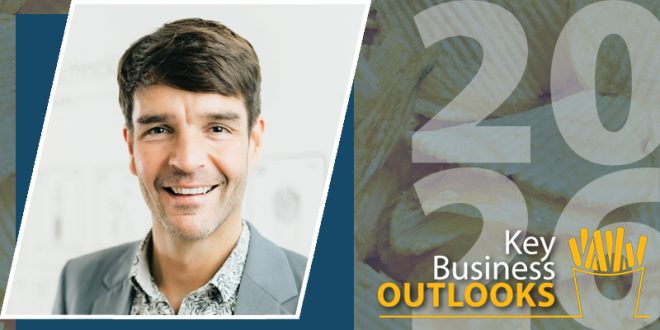


Key Business Outlooks 2026: Daniel Leighty, Vice President of Sales at Key Technology
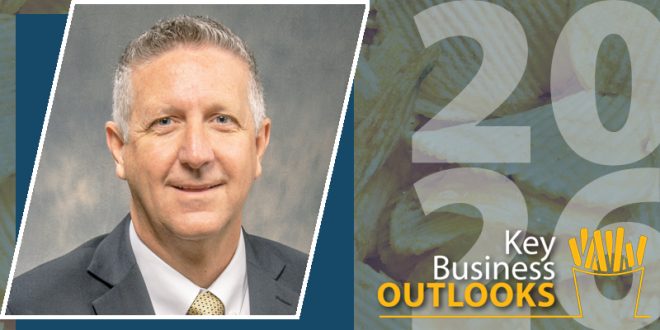
Key Business Outlooks 2026 sees Daniel Leighty, Vice President of Sales at Key Technology, outlining how uptime, reliability, and total cost of ownership have shifted from competitive advantages to non-negotiable requirements for potato processors. He explains why tariff pressure and inflation are reshaping investment pacing rather than intent, how processors are prioritizing efficiency gains from existing assets over headline capacity growth, and why localized service, standardized systems, and predictable performance are becoming central to equipment selection as the sector plans for the years ahead.
Looking back at 2025, which customer pressures proved structural rather than temporary, and how did they reshape your commercial or product strategy?
Several of the challenges that intensified in 2025 are clearly structural. Potato processors are under sustained pressure to lower operating costs, simplify operations and keep lines running as much as possible, even as internal resources continue to shrink. Their expectations around uptime, reliability and total cost of ownership have always been part of the equation, but these are now absolute requirements rather than differentiators.
In response, we’ve adjusted how we go to market and support customers globally. There’s greater demand for direct engagement, localized service and parts availability, and solutions that can be deployed and supported closer to where production happens. That has reinforced our focus on standardized, scalable systems and regional capabilities that help customers operate more predictably in a volatile environment. At the same time, processors are placing greater emphasis on total cost of ownership, favoring solutions that deliver consistent performance with simpler technology rather than pushing the limits of sophistication.
As you plan for 2026, which market assumptions are you revising, and where do you see the greatest hesitation or uncertainty among your customers?
One of the biggest assumptions we’re revising is the pace at which large-scale capital investments will return in mature markets. While demand fundamentals remain strong, tariff uncertainty and persistent inflation continue to slow decision-making, especially for projects with long lead times or complex international sourcing.
Customers aren’t stepping away from investment altogether, but they are being more cautious and deliberate. We’re seeing more phased projects, tighter scopes and greater scrutiny around payback and capital efficiency. That uncertainty is shaping how we work with customers as we help them prioritize investments that deliver near-term operational improvements while keeping longer-term expansion options open.
How do you expect investment behavior among processors to evolve in 2026, particularly regarding capacity expansion, efficiency upgrades, and automation?
In 2026, we expect most processors to focus less on headline capacity expansion and more on extracting additional throughput from existing assets. Unlocking hidden capacity through automation, improved sorting accuracy and better process control is becoming the preferred path, especially when capital is constrained.
Automation investments are also increasingly targeted at reducing labor dependency and improving consistency rather than fully replacing operators. Customers want solutions that stabilize operations, reduce variability and support higher uptime without introducing unnecessary complexity.
Where did your strongest growth opportunities come from recently, and what did those projects reveal about changing customer priorities?
Our strongest growth continues to come from emerging markets such as Brazil, India and China, where processors are building capacity to serve growing domestic demand. At the same time, we’re seeing significant global shifts in where fries are produced and supplied, as processors reassess sourcing, export and production strategies to respond more quickly to changing market conditions and regional demand.
These projects tend to prioritize dependable operation, ease of use and local support rather than customization for its own sake. What they reveal is a broader change in processor priorities globally. Regardless of region, customers want equipment that performs consistently, can be supported locally and delivers value quickly. That mindset is increasingly influencing purchasing decisions even in more mature markets.
How do you balance near-term customer demands with longer-term R&D investment, especially in a more cautious capital-spending environment?
With more than 75 years of experience in food processing technology, we’ve learned that Key’s long-term relevance depends on our continued investment in product development and engineering, even in uncertain markets. We remain committed to R&D focused on efficiency, automation and data-driven performance, while making sure those innovations solve real operational problems today.
Close collaboration with customers and partners is critical to that balance. By working alongside processors as well as trusted engineering and integration firms, we can ensure that new technologies translate into practical improvements on the plant floor, not just future potential.
Which developments in 2025 most disrupted your planning or sales pipeline, and how did your organization adapt?
Tariffs and inflation created significant uncertainty in 2025, leading to delayed approvals, shifting timelines and re-scoped projects. In many cases, customers needed more time to evaluate risk and adjust capital plans, which affected the sales pipeline across the industry, particularly in certain regions.
We adapted by becoming more flexible in how we structure projects and by emphasizing modular, scalable solutions. Helping customers phase investments or prioritize high-impact upgrades allowed projects to move forward even in a challenging market.
What is your five-year vision for processing technology in the potato sector, and how does your company plan to remain relevant as customer expectations mature?
Over the next five years, we expect potato processors to continue pushing for more localized support, predictable performance and equipment aligned with regional market conditions. That’s already shaping how we go to market today.
We’re making deliberate investments to bring service and parts closer to where our customers operate, including expanding our network of regional parts depots in several countries and building in-country service teams that can respond faster, reduce travel-related costs and have a deep familiarity with local regulatory and production requirements. We’re also working more closely across the family of brands within Duravant, our parent company, to help customers get more value from each capital project. At the same time, building and supporting equipment closer to customers reduces exposure to tariffs, VAT and logistics complexity, which are now factored more directly into capital planning decisions.
As operating environments grow more complex and customer expectations continue to rise, the role of trusted technology providers will only become more important, and that’s where we see our future.