

Cutting Technology Under Pressure: Translating Product Innovation Into Industrial Reality
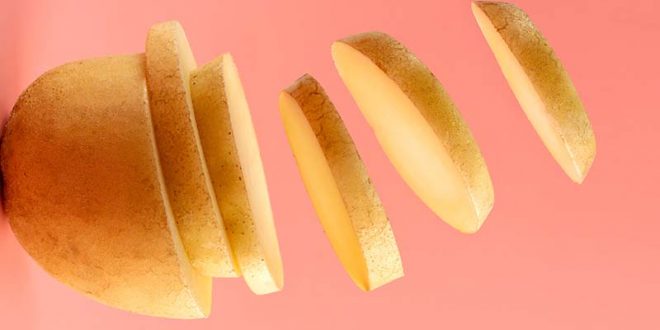
Pressure to differentiate potato products no longer stops at seasoning, coating, or packaging. Processors are being asked to deliver new shapes, textures, and cut profiles that stand out in both retail and foodservice. What looks like a product development exercise quickly becomes a processing challenge once those cuts have to be produced at industrial scale, across variable raw material, and at the speeds modern lines demand.
That shift is one reason cutting technology has moved much closer to the center of line design and line stability. According to Bjorn Thumas, Business Development Director, FAM Stumabo, “Cutting technology has evolved from being a purely mechanical step into a critical control point for both product quality and line stability.”
He places that development in a wider market context: “The global potato processing market is under pressure. Recent greenfield projects and expansions have created ample production capacity, combined with excessive potato crops in Europe. Emerging export hubs, China and India, continue to grow their share in exports to the Middle East with aggressive pricing, pushing out European and North American volume. In the mids of all of this, changing tariffs between countries created extra insecurities. The current geo-political situation in the Middle East adds extra uncertainty and will increase further cost due to mounting fertilize prices, energy becoming more expensive and potential slower demand in the affected countries. This situation is placing increasing pressure on processors to deliver consistent quality at high throughput levels and to achieve optimal operational efficiency.”
Cutting As A Control Point In Line Performance
In that environment, the cutting step has consequences well beyond dimensional accuracy. As Thumas explains, “In this context, cutting is no longer only about achieving the required shape or size. It directly influences how the product behaves throughout the rest of the process. Cut accuracy affects downstream performance in blanching and frying, contributes to more uniform cooking, and plays a key role in final product consistency.”
That link between cut formation and the rest of the line is where cutting technology becomes more than a machine choice. “This shift has repositioned cutting as a central element in overall line performance. Solutions that combine precise cutting principles with stable, repeatable operation help ensure consistent output and reduce process deviations from the very start of production,” Thumas says.
Managing Raw Material Variability At Scale
One of the main reasons this remains technically demanding is the raw material itself. Potatoes do not arrive at the cutter as a uniform input. “Potatoes vary significantly in size, shape, dry matter content, and internal structure depending on variety, origin, and season. These variations directly influence how the product behaves during cutting and must be managed to achieve uniform results,” says Thumas.
That means cutting consistency depends on far more than blade sharpness alone. “From a technical perspective, this requires a robust cutting setup that can accommodate these variations without constant adjustment. Selecting the appropriate cutting principle is essential, but it must be supported by effective product handling. Controlled infeed, proper alignment, and stable product guidance all play a key role in ensuring consistent interaction between the product and the cutting elements.”
The tool itself remains decisive. “The design of the cutting tools is equally important. Blade geometry, edge profile, and material characteristics determine how cleanly the product is cut and how stable that performance remains over time. Maintaining sharpness and dimensional accuracy is critical to avoid deviations during continuous operation.”
Setup repeatability is another factor that can easily be underestimated in high-capacity environments. “In high-capacity environments, even minor variations in tool installation or machine configuration can affect cutting results. Solutions that ensure the correct positioning of cutting components and simplify setup procedures help eliminate this source of variability,” Thumas says.
Throughput Without Compromising Product Integrity
As processors push capacity higher, the balance between speed and product quality becomes more delicate. Throughput cannot simply be increased by running harder. “Increasing line speed alone is not sufficient. If cutting is too aggressive or insufficiently controlled, it can lead to breakage and surface damage, affecting the uniformity of the product and the stability of subsequent processing stages,” says Thumas.
FAM Stumabo frames the answer in terms of controlled interaction between product and cutting element. “Cutting technology plays a key role in addressing this challenge by controlling how the product interacts with the cutting elements. Modern cutting solutions are designed to achieve precise, controlled separation of potato tissue, reducing mechanical stress on the product while maintaining cutting accuracy at higher capacities.”
He points to one specific example in potato chip applications: “Technologies such as the Scalibur™ slicer, with its dual rotation cutting principle, allow processors to maintain high throughput while reducing mechanical stress on the product, helping preserve slice integrity and improve consistency.”
The same logic applies in French fry production, where yield losses can accumulate quickly over time. “In high-capacity environments, even minor deviations in cutting performance can translate into measurable material losses over time. Off-spec product, trimming losses, and reprocessing requirements all reduce the effective use of raw material and increase operational costs,” Thumas says.
Blade Engineering And Yield Optimization
On that point, he cites the SureTec 240P with SureCut Unit: “In French fry processing, solutions such as the SureTec 240P equipped with the SureCut Unit (SCU) help ensure cutting accuracy from the start of each production run, reducing setup-related losses and supporting more consistent raw material utilisation.”
Blade design and blade manufacturing are central to sustaining those results. “Blade design is a critical factor in achieving stable, predictable cutting performance over time, as it directly determines the interaction between the machine and the product,” says Thumas. “When blade design and production are developed in-house, as is the case at FAM STUMABO, it enables a much closer alignment between cutting tools, machine design, and specific application requirements.”
He also stresses metallurgy and wear behavior as practical processing issues rather than abstract engineering points. “Achieving the right balance between hardness and ductility ensures that blades maintain sharpness over time while resisting mechanical stress, supporting stable performance across long production cycles.”
Integration Within The Processing Line
Cutting equipment is no longer treated as a standalone unit but as part of a fully interconnected processing system. Its performance must align with upstream preparation stages and downstream thermal processing, where even small deviations can propagate through the line. Integration enables more stable operation by ensuring consistent output, while also supporting process monitoring through real-time visibility of key parameters. This allows operators to identify deviations early and maintain tighter control over overall line performance.
Equipment Capability Across Applications
Within industrial potato processing, Urschel Laboratories structures its cutting solutions around specific application requirements, covering slicing, strip cutting, dicing, and particle size reduction across high-capacity production environments.
At the core of its potato chip processing offering is the CC Series, which the company describes as “the leading high yield potato slicer across the globe in use by over 90% of all commercial potato chippers.” The platform supports a wide range of slicing configurations through interchangeable cutting heads, enabling processors to produce flat slices, V-cuts, crinkle slices, shreds, strips, and other profiles aligned with product specifications.
For lattice and specialty cuts, Urschel includes the CCLL slicer, designed for “corrugated cuts to create potato lattice chips or thicker potato waffle fries.” The system is engineered for higher-capacity production compared to earlier models, incorporating multiple cutting stations and an enlarged cutting chamber to support increased throughput.
From Slicing To Dicing And Particle Reduction
Beyond chip slicing, Urschel extends its cutting capability through the DiversaCut Series, which provides flexibility in producing crinkle, deep crinkle, and straight-edged dices and strips for French fries and other potato products. These systems are designed to handle a range of product sizes while maintaining consistent cut geometry under continuous operation.
For applications requiring further size reduction, Urschel deploys its Comitrol line, described as “a purpose-engineered line for potato particle reduction.” The technology is used in processes such as flake production and other applications where controlled particle size is critical. Designed for continuous operation, the system uses fixed-position reduction heads and high-speed impeller action to achieve uniform results at high throughput levels.
New Developments In Cutting Technology
Urschel is introducing a new cutting concept with the Little Gem Aspire Dicer, developed by its Innovation and Development team. According to the company, “The Little Gem employs patented Urschel technology to create precision cutting methods, engineered through extensive R&D.”
The system is designed to produce slices, strips, and dices within a compact footprint, with configurations supporting flat slices from 2 mm up to 20 mm and a range of strip and dice dimensions. The machine incorporates a StatiCut assembly and specialized knife configurations intended to reduce cell damage and support juice retention, contributing to improved product yield and consistency.
Aligning Equipment With Processing Requirements
Urschel places emphasis on aligning cutting equipment with the broader processing environment rather than treating it as an isolated unit. As Scott Klockow, Director of Applications and Product Development, explains: “We speak to customers to understand their processing line, their product, and their yield goals first. That way, their Urschel equipment is aligned with their operation from the start and integrates seamlessly into their production.”
This approach is supported by in-house manufacturing of critical components, including knives, which contributes to operational reliability and supply continuity. Dennis Wong, Director for Urschel Asia Pacific Singapore, notes: “Because we manufacture critical parts and knives, we can control inventory levels better and we have reduced supply chain risk.”
Taken together, the input from both companies points to the same broader conclusion: cutting is where product ambition collides with raw-material variability, mechanical limits, and line-speed demands. As processors continue to pursue new formats and tighter operational performance, cutting technology is being asked to do more at once: create more distinctive products, preserve product integrity, maintain repeatability, and fit cleanly into increasingly integrated production lines.
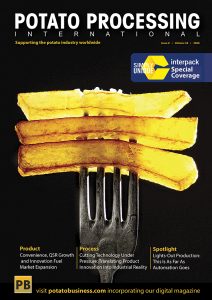
Read the rest of this feature in the free e-copy of the March/April Issue of Potato Processing International, which can be accessed by clicking here.