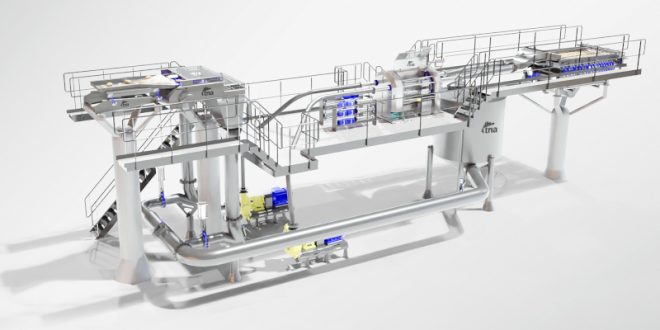


Potato Grading: The First Constraint On Processing Performance

Grading accuracy directly determines usable yield, line stability, and compliance risk in industrial potato processing. Size distribution, shape conformity, and defect separation at intake influence peeling losses, cutting efficiency, thermal treatment uniformity, oil uptake, and finished product consistency. Variability that passes through grading propagates downstream as inefficiency, quality deviation, and avoidable cost.
In processing environments, grading functions as a control point rather than a preparatory step. The objective is not classification for trade presentation but conditioning raw material to the tolerances required by mechanical, thermal, and chemical unit operations that follow. Peeling systems, cutters, slicers, fryers, dryers, and freezing tunnels are all designed around defined dimensional and quality windows. When grading fails to enforce those windows consistently, equipment operates outside optimal parameters.
Size variation increases peel loss through over-peeling of small tubers and under-peeling of oversized ones. Irregular shapes destabilize cutting geometry, leading to increased fines, edge defects, and higher trim rates. Internal and external defects that escape grading introduce variability in moisture migration, starch gelatinization, and color development during frying or dehydration. The cumulative effect is reduced yield predictability and higher rework or downgrade volumes.
From an operational standpoint, grading quality affects line balancing. Inconsistent grading forces processors to slow downstream equipment, increase buffer capacity, or accept higher reject rates later in the process, where value has already been added. Grading therefore defines not only raw material quality, but effective plant capacity.
Technical Constraints Governing Grading Performance
Industrial potato grading operates under three primary constraints: measurement fidelity, throughput compatibility, and system robustness.
Measurement fidelity requires accurate, repeatable assessment of three-dimensional size, shape, and surface condition at line speed. Mechanical sizers provide coarse dimensional separation but cannot resolve shape irregularities or surface defects with sufficient precision for modern processing requirements. Vision-based systems address this limitation by capturing multi-angle images and deriving volumetric and morphological parameters in real time.
Throughput compatibility is equally critical. Processing plants handling tens of tonnes per hour require grading systems that match or exceed upstream intake capacity without becoming a bottleneck. Imaging resolution, processing speed, ejector response time, and lane configuration all impose limits on achievable throughput. Systems that perform well in isolation can underperform once integrated into continuous, high-density material flows.
System robustness determines operational uptime. Optical components are sensitive to dust, soil residue, vibration, and moisture. Grading systems must maintain accuracy under variable field conditions and seasonal crop variability while allowing for rapid cleaning, calibration, and maintenance. Any degradation in sensor performance increases false rejects or false accepts, both of which carry cost implications.
Regulatory Context And Specification Compliance
Although grading for processing is primarily driven by internal performance requirements, regulatory standards establish baseline definitions that influence procurement contracts and audit expectations. In the United States, USDA grades for potatoes for processing define requirements for firmness, freedom from defects, and minimum size thresholds. These standards are routinely referenced in grower contracts and quality assurance protocols, even when product is destined for further industrial transformation rather than the fresh market.
In export-oriented operations, grading outputs must also align with destination market specifications and food safety frameworks such as HACCP and ISO 22000. Documented grading data supports traceability, lot segregation, and verification during customer or regulatory audits. Inadequate grading records increase compliance exposure, particularly when defects linked to raw material quality emerge downstream.
It is important to separate regulatory grading definitions from operational grading targets. Processors often impose tighter internal criteria than those required by commodity standards in order to protect yield and finished product performance.
Cost, Yield, And Energy Implications
Grading decisions directly affect cost structure. Aggressive defect removal improves downstream consistency but increases raw material loss. Lenient grading preserves mass yield but shifts cost to later stages through higher trim rates, reprocessing, or downgraded finished product. The optimal balance depends on product category, margin structure, and customer tolerance.
Energy consumption is also influenced by grading quality. Uniform size distribution improves heat transfer efficiency in blanching, frying, drying, and freezing operations. Variability forces operators to extend dwell times or increase energy input to accommodate worst-case units, raising specific energy consumption per tonne of finished product.
Capital and operating costs must be evaluated together. Advanced grading systems require higher upfront investment and ongoing maintenance but can reduce waste, stabilize throughput, and improve overall equipment effectiveness across the line. The economic justification lies in system-level performance, not standalone equipment cost.
Read the rest of this feature in the free e-copy of the January / February Issue of Potato Processing International, which can be accessed by clicking here.