

Using the Right System for the Frying Process is Essential

Although the frying process has remained largely unchanged for decades, its efficiency and operational capabilities are continuously being upgraded and adapted in order to meet customer needs and reduce production costs.
As the most complex step in potato processing, frying requires several highly efficient processing steps, tools and associated techniques in order to produce the throughput and quality demanded by today’s market.
No Two Systems Are the Same
The main solutions for potato processing at Kuipers, for example, are the chips and the French fry lines. Kuipers generally focuses on smaller capacities, from 250 to 1000 kilograms per hour output for chips and up to 2000 kilograms for French fries. According to the company, this approach enables better control over the process and ensures a high-quality output is achieved. “We help our clients lower their oil usage costs with an innovative fryer design that requires minimal frying oil volume. The design combined with an optimized process helps processors to significantly lower their oil as well as general labor costs. Our plants also include one of the most advanced water treatment systems, a system that continuously recycles the water throughout various stages of production,” says Valeria Lucinschi, business development manager Kuipers.
She reveals that each processor has a different need and by analyzing that need they craft custom solutions. While it may seem that a system is equal to another in terms of capacity or type of snack, however, in reality, tailoring happens either in the process or the design of the system or both. “At Kuipers we don’t offer a standard solution, we discuss the processor’s particular need and the available resources and build a solution that will deliver the optimal result,” she adds.
Synergy with the Production Line
Arnaud Jansse, applications engineer, Product Development, tna solutions explains that the latest advances in oil management and filtration have helped improve frying processes over the past few years. Especially as concerns around health and wellness continue to gain momentum, processors have been looking for new ways to ensure potato products are always cooked in the highest quality oil – to keep consumers coming back for more.
“Our portfolio of fryers has been developed to suit a wide variety of processing requirements. The tna Florigo conti-pro® PC 3 is our latest potato chip fryer with built-in opti-flow® technology. It works by optimizing oil flow throughout the kettle, to ensure each potato slice is evenly fried. It also removes almost all dead spots at the start of the fryer, to help maintain nominal speed and prevent debris from settling. Its multi-flow oil injection system and automatic temperature control means processors can adjust the frying process quickly and easily to achieve the right potato chip texture and quality,” says Jansse.
tna also manufacturers continuous frying systems specifically designed for processing French fries and specialty potato products, as well as atmospheric batch fryers and continuous vacuum frying equipment.
“Once we have understood their requirements, our experts can recommend different features to optimize the frying process accordingly, while ensuring complete synergy with the rest of the production line. Whether it’s adding a fully integrated defatting belt for a potato chip, or an oil mist eliminator to maintain power output, there’s a tailored option for everyone,” adds Jansse.
Controlling All the Variables
Mick Walsh, chief engineer, Heat and Control says their company has well-developed solutions to most applications and can advise new partners on ideal ways to process their product. “Chances are, we have experience with their product and have within our standard range the right equipment to deliver a premium solution. We can tailor a package to the customer’s needs and ideas with variations in preparation, heating, filtration, seasoning and packaging.”
According to him, depending on the raw material and type of product texture required, they can mix and match different types of washing, blanching, electroporation, salt washing and drying solutions, all from their regular playbook.
“We explain the benefits of each piece of equipment and how it will deliver the result the customer wants. Whether it is a simple, entry-level PC processing line for an emerging market or a world-leading French fry line, new customers can rely on Heat and Control to supply a system that will deliver the goods,” Walsh points out.
When working with developed industry partners, Heat and Control can customize solutions to a wide range of individual requirements. Fryers will be engineered for particular cook times, product throughput and temperature profiles. Filtration systems can be tailored to suit particular products, from battered French fries to peanuts and more. OEM requirements such as PLC brands, belting types and others can all be accommodated with their partners.
Future-proofing Production Lines
Göran Wadsten, senior advisor, Rosenqvists Food Technologies says they offer a unique solution for processors that have a batch fried chips production and consider launching a normal fried chips line or vice versa. “Both these scenarios raise the question: Do I dare to invest in a completely new line for a dedicated product? The answer is: ‘Yes!’ Rosenqvists Food Technologies has developed a patented dual function fryer. A fryer for true batch fried chips and for normal potato chips. All in the same pan. The conversion from batch to normal chips will take two hours only,” Wadsen explains.
According to him, the market has seen a growing interest for batch fried chips over the last 7-8 years. So the company designed a pan that has two different systems inside its hood, which can be switched. Each one has the required elements needed to transform the fryer between continuous and batch style production.
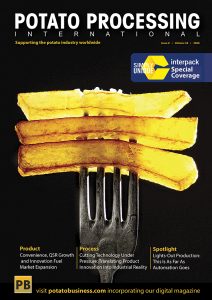
You can read the rest of this article in your complimentary e-copy of the May/June Issue of Potato Processing International magazine, which you can access by clicking here.