Enabling Real-time Data Collection and Sharing Between Various Resources
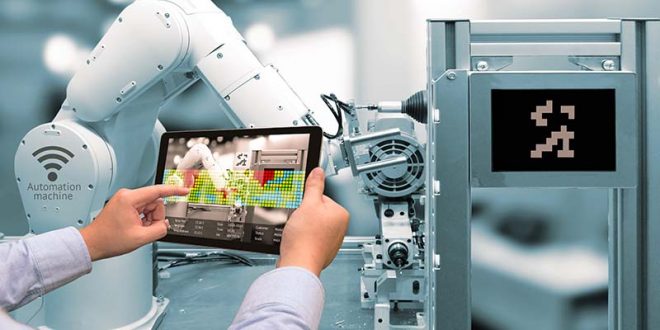
The term Internet of Things (IoT, for short) refers to the convergence of traditionally connected gadgets and smart appliances that are all linked to the Internet and working together as a system.
IoT is one of Industry 4.0’s nine key technologies and is a relatively new manufacturing idea. It consists of cutting-edge IT infrastructure for data distribution and gathering, which has a big impact on the effectiveness and performance of manufacturing systems.
IoT enables real-time data collection and sharing between various resources, including machinery, personnel, supplies, and tasks. Sensors, radio frequency identification (RFID), and wireless communication standards are frequently used in real-time data gathering. With the aid of these technologies, it is possible to track and monitor important manufacturing-related data, the movement of materials or people, and a variety of other information in real-time, providing complete visibility and traceability of manufacturing processes. This enhances the effectiveness and efficiency of manufacturing operations by enabling management to make quicker and better choices based on real-time information.
Some businesses are now considering IoT as a way to boost operational effectiveness and its potential advantages by using it as a tool to discover growth in unexpected possibilities. Creating new terms within the IoT concept, such as Industrial IoT (IIoT), and incorporating more elements, also quickened the pace of IoT growth. They predicted that in the future, prosperous businesses would use IIoT to boost production, create new hybrid business models, take advantage of intelligent technologies to fuel innovation, and change their workforce to increase their revenues.
IoT is advancing quickly, and it can be improved even more by merging it with other technologies like cloud computing, the future internet, big data, robotics, and semantic technologies.
IIoT is frequently utilized in the production sector to concentrate on industrial applications. It stands for the IoT’s industrial subclass, which is already beginning to transform the manufacturing industry and usher in a fourth industrial transformation known as Industry 4.0. The goal of Industry 4.0 is to create intelligent factories where manufacturing technologies are enhanced and changed using cloud computing, IoT, and cyber-physical systems (CPSs). To build manufacturing systems that are interconnected, with the ability to communicate and analyze the gathered data to make better choices, Industry 4.0 integrates advanced manufacturing techniques with the IoT.
Operational efficiency is an important aspect of IIoT, which is achieved by employing automation and agile production techniques such as predictive maintenance to prevent downtime and plant and facility shutdowns. Companies are starting to realize the huge potential of IIoT: the universe of intelligent industrial products, processes, and services that connect with people over a worldwide network thus boosting new growth opportunities by adding digital services and innovation to their product mix.
You can read the rest of this article in your complimentary e-copy of Issue 1 of Potato Business Dossier 2023, which you can access by clicking here.