

Australia Turns to New Zealand for Lessons After Mop Top Virus Discovery

Australia’s potato industry is confronting a new biosecurity challenge as Potato Mop Top Virus (PMTV) has been confirmed for the first time in the country. The pathogen was detected in north-west Tasmania in July 2025, marking a significant shift for a region long regarded as Australia’s “potato capital.”
Following extensive testing, Tasmanian authorities destroyed 1,700 tonnes of infected seed potatoes ahead of the planting season. The National Management Group has since ruled the virus not eradicable, meaning long-term containment strategies will be required.
Local growers are adjusting to the new reality. Veteran farmer Stuart Applebee, who has grown potatoes in north-west Tasmania for decades, told SBS News: “Like any new virus, it’s quite concerning when you know you’re probably the first state to be detected in the country with it.”
He added that learning from neighbouring markets helped ease initial fears: “Once we found out a little bit more out of New Zealand and a couple of other countries that are dealing with it, that probably relaxed my own thoughts a little bit.”
The detection has raised questions about how the virus entered Australia. TasFarmers CEO Nathan Calman described the discovery as “a failure of our national biosecurity protocols, but also our state biosecurity protocols.”
The Department of Agriculture, Fisheries and Forestry told SBS News that the government has increased biosecurity resourcing by AUD 2 billion since taking office, stating: “Australia has a world-leading national biosecurity system, which is critical to our economy, environment and way of life.”
Chief Plant Protection Officer Gabrielle Vivian-Smith said it is still unclear how the virus arrived: “It’s not known exactly how it arrived in Australia, it potentially could have come in on a number of different pathways.”
PMTV has been identified at multiple sites in Tasmania, including production areas, storage facilities and a research station. The only mainland detection so far has been in seed potatoes stored in Victoria. In response, Victoria, New South Wales and South Australia have all imposed restrictions on the movement of potatoes and farm equipment from Tasmania.
Zarmeen Hassan, biosecurity manager at AUSVEG, warned that the situation could extend beyond the island: “So far we know that it’s only in Tasmania, right? We don’t actually know whether it has spread to the mainland.”
She added: “If it has not spread to the mainland, then obviously the industry and government want to work towards containing it.”
New Zealand detected PMTV in 2018 and has since adopted a long-term management approach focused on hygiene and soil health. Potatoes New Zealand CEO Kate Trufitt told SBS News: “We’re not seeing lost yields, we’re not seeing anything, but they do call it the sleeping disease.”
She said the country is now researching resistant potato varieties and stressed that washing down machinery, crop rotation and soil improvement are essential to containment.
Tasmania’s Primary Industries Minister Gavin Pearce said the state is following similar advice and has allocated AUD 200,000 to a joint research program on PMTV and powdery scab, the latter being the virus’s known vector. “We’ve looked to our friends across the ditch in New Zealand who’ve told us that the key to mop top management is addressing powdery scab,” Pearce said.
According to Hassan, the challenge is widespread: “If that’s the case, then [PMTV] may be further than Tasmania. We don’t know that, it’s a bit of an unknown right now.”
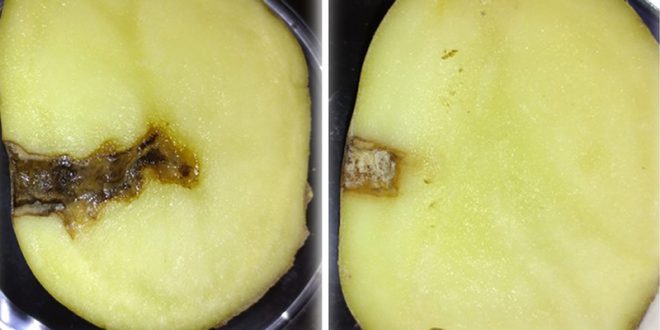
While PMTV poses no risk to human health, it can damage tuber appearance and reduce yields, potentially impacting Australia’s seed and processing sectors. With eradication ruled out, the industry is expected to focus on integrated soil-borne disease management and enhanced biosecurity at planting and transport stages — lessons already well learned in New Zealand.