

Finding Higher-quality Potatoes Through Science and Hard Work
Every year, during the height of harvest, the University of Maine’s Agricultural Research and Development Farm in Presque Isle examines about 250 different potato varieties to find higher-quality potatoes for businesses that make the popular frozen potato products, fries, and chips.
“You can see this is just a pretty smooth skin; it’s bright in the marketplace. It would jump out on the shelf if someone was going to buy them. It has to yield well; it has to have the tolerance to some of the important pests and diseases, or more stress tolerant varieties which can help with warming, changing climate,” UMaine agronomy professor, Greg Porter, said.
Professor Porter has devoted the last 40 years of his life to creating high-quality potatoes to increase Maine’s competitiveness and marketability.
Since spuds are a significant source of revenue for Maine, the University of Maine’s potato research team receives hundreds of thousands of dollars in federal funding each year to create new kinds, including the popular Caribou Russet.
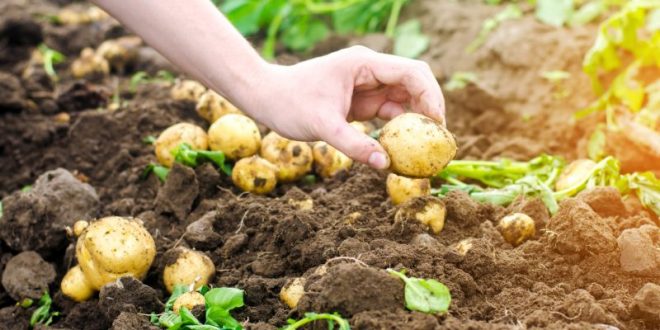
Students and seasonal laborers pluck each variety of potato one at a time during the height of harvest. They are then graded, labeled for quality and yield, and transported back to UMaine’s main campus in Orono for the remainder of the research.
“I enjoy it. I mean, it’s not hard work. It’s work that needs to be done,” Larry Sawyer, who has been working for many years as a tractor driver and field worker during peak harvest season, said cited by News Center Maine.
Maine currently ranks as the nation’s fifth-largest producer of potatoes.
“We got every market class represented here, from chipping and fresh market to specialty varieties that small roadside stands growers would grow to french fry processing varieties,” Porter mentioned.
The UMaine Orono campus is where the procedure begins. Thousands of real potato seeds are produced as a result of the cross-pollination of potato plants in Orono greenhouses. After then, 50,000 plants are grown in Presque Isle by researchers and students using those seeds. The top 250 plants are then chosen over two years.
Porter stated that his team receives funding from the US Department of Agriculture, the University of Maine, the Maine Potato Board, and other public sector grants to continue their research. For example, in 2022, the USDA gave the program USD227,000 while the Maine Potato Board gave it USD60,000.
Porter indicated that after extensive investigation, one-third of the finest 250 varieties will be chosen.
“The ones that are left that look very promising will go out to commercial trials. They’ll start being looked at by growers, french fry processors, and our chip processors. Only a few of them get released commercially. The Caribou Russet was an excellent example of that, where it looked very good in research, [so] growers and processors started looking at it,” he declared.
“Caribou Russet has been a game changer for the Maine industry. Not only because it’s a dual purpose, but also does well in dry conditions,” Maine Potato Board director Don Flannery said.
Flannery stated that the demand for Maine potatoes has been quite strong, which is why this research is so vital.
“People continue to rely on Maine as a very stable source of whatever potato they are looking for. The last three years, we’ve seen an uptick in acres in Maine due to demand,” Flannery mentioned.
“It’s valuable to me that my research is contributing to an important crop that keeps families on family farms and helps generate revenue for our state,” Porter declared.
According to USDA data, Maine potato sales in 2021 will be slightly more than USD200,000,000, an all-time record.
Porter is expected to retire at the end of the year after all of his efforts in the UMaine potato research program. He released five varieties, one of which was the Caribou Russet.