

The Next Round of Phenotyping Potato Stress Acclimation
The EU Horizon 2020 project Accelerated Development of multiple-stress tolerAnt PoTato (ADAPT), in which Europatat is involved, seeks to develop new strategies to make potatoes suitable for the future’s challenging growth conditions.
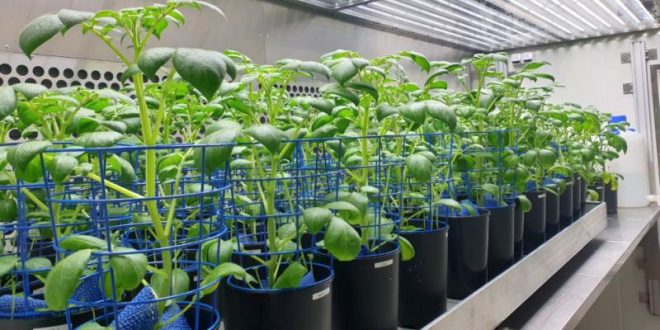
The research has now entered its final phase and in March 2023 a new round of automated high-throughput phenotyping with two selected varieties will be carried out. This task will be carried out at the Brno headquarters of screening technology developer Photon Systems Instruments (Czechia).
“Starting from tissue-cultured plantlets, the varieties Desirée and Lady Rosetta will be grown on soil under strictly controlled environmental conditions. These two varieties were selected from the previous field trials that have been carried out in the consortium during the past two years in Spain, the Netherlands, and Austria. Moreover, glass house trails done at the Universities in Erlangen, Utrecht, and Wageningen showed contrasting levels of tolerance to the two different stresses that are studied by ADAPT; heat- and drought stress as well as water logging (both at a single level but also in combination, which is more realistic given the climate change),” according to a recent Europatat press release.
During the first part, the scientists improved the experimental setup, such as the intensity and duration of stress treatments, as well as the ideal time for sampling. Based on the data collected thus far, they can now investigate these processes in two distinct potato varieties and combine automated phenotyping with a thorough analysis of morphological and physiological responses to various stresses. Furthermore, the biochemical and molecular changes that occur in reaction to single and combined stresses will be measured and analyzed at the network level to understand how potato plants adapt to these stresses and why some varieties perform better than others.
“For this purpose, ADAPT researchers will again take several samples at critical time points during the experiment, which will then be analyzed by multiple omics approaches. At the Universities of Erlangen and Vienna, ADAPT researchers will follow the changes in the proteome and metabolome, and in Olomouc the plant phytohormones will be measured while at the National Institute of Biology (NIB) in Ljubljana, the changes in gene expression will be monitored,” the document reveals.
The stress response models that were created by the NIB team using prior data and the most current findings of the ADAPT project will then be updated as a result of the further integration of all these data. The Stress Knowledge Map, which was created by the NIB team as part of the project, contains this data collection. This network analysis will aid in the identification of key nodes for adapting to various stresses, which will then be used to create markers for the breeding of future potato varieties that are more tolerable.