

U.S. Scientists ‘Zapped’ Genetic Material Into Tiny Potato-eating Root-knot Nematodes
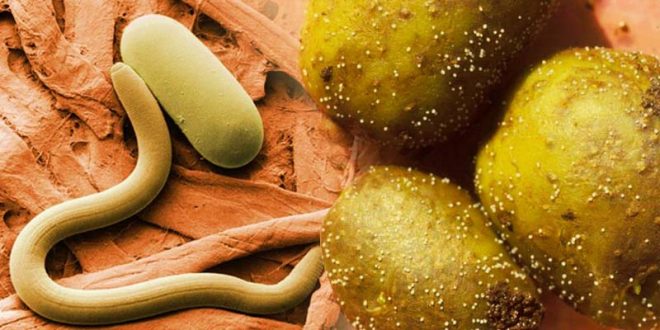
A group of ARS and university scientists decided to delve deeper into the fundamental biology of root-knot nematodes (among others), particularly their genes for reproduction.
To accomplish this, they devised a “workaround” in the shape of electroporation. In a nutshell, the method entails immersing nematodes in a plexiglass chamber with a buffer solution and pulsing it with small electrical shocks. This stuns the creatures and briefly opens pores in their bodies, allowing the solution’s main “active ingredient” – bits of genetic material known as NanoLuc luciferase mRNA – to enter.
“Luciferase is an enzyme that oxidizes a compound called luciferin, producing a type of light called bioluminescence, such as that emitted by fireflies. In this instance, scientists ‘retooled’ a luciferase coding sequence taken from a bioluminescent, deep-sea shrimp and electroporated it into the nematodes,” ARS experts mentioned.
According to Leslie Domier, a plant pathologist (retired) with the ARS Soybean/Maize Germplasm, Pathology, and Genetics Research Unit in Urbana, Illinois, nematodes have primitive nervous systems.
“When they were electroporated, they were immobilized for up to an hour, but then recovered and behaved normally,” he added.
The nematodes were then removed so that the contents of their cells, including luciferase, could be blended into a mixture known as a “homogenate.” The homogenate was then combined with a luciferin-like chemical called furamazine, and bioluminescence was observed.
Rather than observing this with their own eyes, the scientists used biochemical assays and sensitive light-detecting tools to assess the strength of the homogenate’s bioluminescence and the success of their studies.
So far, the researchers have electroporated luciferase mRNA into soybean cyst nematodes (SCN) and root-knot nematodes (RKN), both of which are expensive crop pests, as well as Caenorhabditis elegans, a free-living species that does not require a host to reproduce.
The method, according to Glen Hartman, another plant pathologist (ARS retired) on the study team, opens the door to introducing other synthetic mRNAs into nematodes to show how and where they change, as well as when the nematode’s genes are activated in cells.
Pest-control Applications
There might also be uses for pest control. For instance, electroporation might make it possible to raise populations of soybean cyst nematodes in the lab that have genetic code pieces whose only function is to skew the male-to-female ratio. Theoretically, releasing these lab-raised nematodes into the wild to mate with wild nematodes would ultimately result in a generational population crash.
“We hypothesized that if we could interfere with the sex determination in nematodes, we could reduce nematode populations below crop-damaging thresholds,” Domier added.
That could then lead to a reduction in the demand for chemical pesticides or even help elite, resistant cultivars remain effective longer, among other possible advantages.
Plant parasitic nematodes are tiny roundworms that eat the roots of plants. They reside in soil and plant tissues, and a field may contain more than one species. They have a diverse host range and differ in their environmental requirements, symptoms, and danger to potatoes.
Overwintering root-knot nematode juveniles invade roots and later tubers, establish feeding sites, and develop into the adult stage. Adult females are swollen, and sedentary, and lay eggs in a gelatinous matrix on or just below the root surface. Second-stage juveniles (J2) hatch from these eggs and move through the soil to invade other roots and tubers.
When no crop is present, the nematodes survive as eggs or J2, which can be found in the soil. Root-knot nematode feeding reduces the vigor of plants and causes blemishes on tubers. The latter can lead to a severe reduction in tuber quality and, as a result, affected potatoes become unmarketable. Lesion nematodes damage roots by feeding and moving through cortical tissues.
Collectively, these roundworms are known as plant-parasitic nematodes, and they cause USD173bn in crop losses worldwide each year.