

Four-pronged Approach to Controlling Late Blight Disease
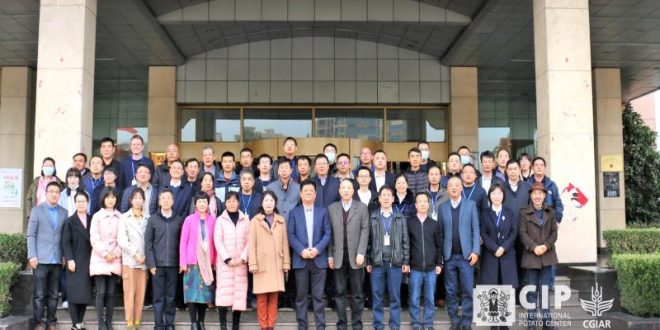
During the 23rd Chinese Potato Conference, held recently in Yulin City, an expert invited to the meeting presented breeding results and disease management approaches of field trials in three planting sites, strong evidence for a four-pronged approach to controlling late blight disease.
Xiao Chunfang of the Enshi Academy of Agricultural Sciences presented detailed research findings thanks to his collaboration with the Yunnan Academy of Agricultural Sciences and the Heilongjiang Academy of Agricultural Sciences.
On this occasion, Chunfang had the chance to speak about the multi-faceted approach to control late blight.
More exactly, in this context, the Chinese expert recommended using late blight monitoring and warning systems for accurate prediction and forecasting, monitoring species resistance to determine the first timing of fungicide application, evaluating fungicide effectiveness in the field to guide the selection and use of the types of fungicides for controlling costs and reducing fungicide doses, and
monitoring fungicide efficacy to plan the next application period.
As in many parts of the world, late blight disease is a scourge to potato farmers who lose millions of dollars (and tonnes of potatoes) to this pathogen each year.
Five years ago, a group of farmers, scientists, and government officials formed the AsiaBlight network to develop an integrated approach to managing and eventually eradicated, late blight disease to improve nutrition and food security for billions throughout Asia.
The network members agreed that the information elicited from these field trials could be used as a reference for other major potato-producing areas in China.
The research findings were complemented by several AsiaBlight displays featured at the conference. The network will hold its next annual meeting in December 2021.