

Consistency is Key to Successful Seasoning

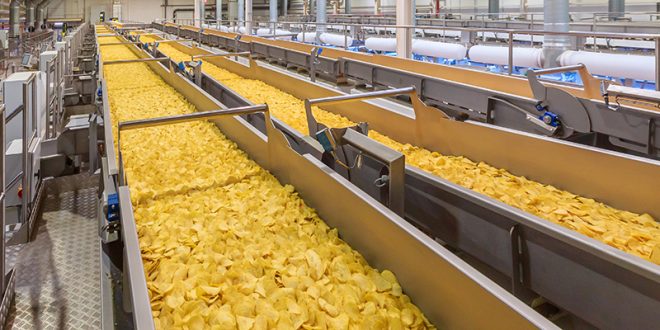
Most potato chips are salted or seasoned just before packaging. The salt and/or seasoning is generally applied when the product is still hot, in order to help it adhere to the surface of the chip. Commercial equipment for the application of seasonings consists of a unit that applies the seasoning by sprinkling it over the potato chips as, they pass to a conveyor belt, while tumbling in a rotating drum, or by electrostatic application.
The salt is usually added first, in very fine crystals, and usually constitutes 1–2% of the finished product’s weight. Seasonings are generally spice mixtures with other ingredients and additives and among the many flavors that can be found in the market, barbecue, cheddar cheese, sour cream and vinegar are the most common ones. The flavoring usage levels vary but represent 5% to 10% of the finished product weight. The overall surface area of the chip should be considered in order to adjust the level of application accordingly. For example, a seasoning developed for a flat, thin potato chip requires a lower usage level to deliver the same flavor impact than seasoning required to deliver flavor on a thicker, ripple-cut potato chip.
There are two different basic methods of applying seasonings. One is in-process or in-kitchen application, where seasonings are applied in the cook room. Such is the case of large potato chip operations where two-stage seasoning is used. Using this method, all chips are salted directly out of the fryer, and then split into two or more streams. Some chips go directly to packaging, while others may go to a tumbler where seasoning is applied and then on to a separate packaging line.
The other method is called on-machine seasoning (OMS). In this case, product is seasoned in the packaging room immediately before weighing and packaging. One of the main advantages of on-machine seasoning is that it allows production to continue without being affected by flavor changes. This increases the productivity of the entire line because industrial equipment is most efficient if it’s operated continuously.
On-machine Seasoning
One manufacturer that offers OMS seasoning solutions is Heat and Control. Their machines come pre-assembled allowing them to be quickly set in place and connected to utilities at the plant, so production can begin without delays. According to the company, OMS systems apply seasoning to snacks just before they enter the weigher to increase production versatility. They allow processors to run a different flavor on each bagger, and by running multiple flavors at the same time, producers can save a lot of floor space. Fryers continue to run during flavor change-overs with higher overall line efficiency achieved.
For example, the company offers the FastBack Revolution Seasoning System, which in combination with the Spray Dynamics Slurry-on-Demand Continuous Mixer provide consistent coverage and simplify snack food seasoning.
The system combines the seasoning performance of the patented dynamic AccuFlavor Tumble Drum, with the Modular Collection System and the FastBack Model 260E-G3 motion conveyor into one compact, cost-efficient, standalone unit, designed to overcome seasoning challenges at the weigher, notes the company. The FastBack 260E-G3 horizontal motion conveyor gently transports the product and features a stainless steel chassis and body designed for improved sanitation, maintenance accessibility and food safety. It can be used for any application in which gentle, powerful, horizontal motion conveying is required for throughputs within specification.
You can read the rest of this article in the Winter Issue of Potato Business Digital magazine, which you can access by clicking here.