

Lower Risk of Potato Bruising and Supermarket Waste Through the TuberTurgor Project
Under Innovate UK’s Analysis for Innovators (A4I) program, B-hive has been granted funds to work with scientists at the National Physical Laboratory (NPL) on the nine-month TuberTurgor project.
The agri-tech research and development company is starting a new cooperative initiative to lower the possibility of bruising potatoes and create technology that may minimize waste from supermarkets.
“Together, the research team will investigate non-destructive methods of measuring turgor pressure in potatoes; this is the force inside cells that pushes outwards, allowing the cells to withstand shocks and reduce bruising,” according to a recent B-hive info, cited by AgriTech Tomorrow.
To establish proof of concept for technologies that could eventually automatically categorize various fresh fruit based on bruise risk, the research will collect a large amount of data.
“Growers and supermarkets are increasingly impacted by potato bruising that is brought on by prolonged periods of drought from rising global temperatures. This can drastically increase susceptibility to bruising damage during handling, so there is a supply-chain need to investigate how this can be reduced through devising early, non-destructive detection measures,” Dr. Barbara Correia, UKRI Future Leaders Fellow and TuberTurgor project lead at B-hive, said.
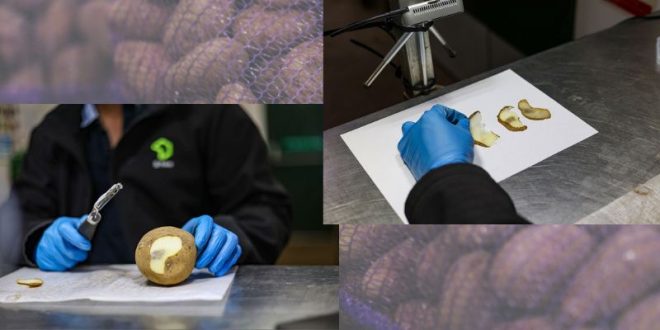
In close cooperation with the NPL team, B-hive will evaluate several potential turgor pressure measurement methods by using its technological know-how and access to turgor analysis techniques. A variety of methods will be investigated, such as high-resolution imaging techniques, ultrasonic and spectroscopic tests, and physical hardness measurements.
The team’s first testing phase, which will identify the most effective testing procedures, will take place from August to October following an initial period of protocol definition. Continuous improvements will guide the second testing phase, which is scheduled to commence in November and gather copious data for the most successful strategies. The project is expected to conclude in March.
“NPL has a long history in the development of measurement techniques, and we are excited to be able to apply our expertise to an issue that so directly influences agricultural productivity and the environment,” Dr. Tony Maxwell, technical lead at the National Physical Laboratory, added.
The TuberTurgor project is the agritech company’s most recent fresh-produce analysis study, according to Dr. Andrew Gill, general manager of B-hive. It was created to assist supply chains in reducing wastage.
“Bruising contributes to enormous losses in productivity and reputational damage for both growers and supermarkets. We are delighted to have secured funding that could help to retain a high overall quality of end produce, as growers face ongoing challenges to manage their crop,” Gill concluded.