

Testing Imaging Detection Technology During Extended Potato Season
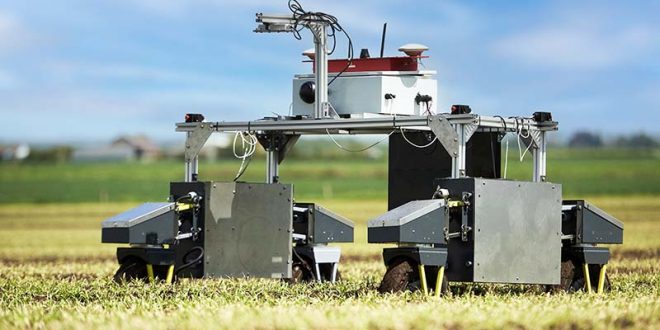
Ground-sensing technology TuberScan, developed by agri-tech company B-hive Innovations and collaborators, is nearing its last phase of testing both overseas and now in the UK, following the commencement of this year’s weather-delayed potato growing season.
In its present version, the TuberScan system consists of a custom ground penetrating radar (GPR) system, GPS units, in-field, and remote sensors, supported by computer vision, and artificial intelligence (AI), which provides precise information on the growth characteristics, and performance, of potato crops.
In addition, the technology determines the location of each potato’s planting, going beyond the growers’ customary sample practices.
Innovate UK has supported TuberScan’s four-year research and development effort spanning two distinct research programs. B-hive has worked together to develop demonstration units with national potato distributor Branston Ltd, The University of Manchester, and Harper Adams University.
The last season of the project, which has already begun with field trials in Mallorca and Lincolnshire, is on pace to be successful, according to Effie Warwick-John, project manager on TuberScan at B-hive Innovations.
“We are looking to collect as many findings as possible into crop performance by September, addressing the lack of clarity that growers currently contend with when trying to predict the growth of their crops underground. The trials in Spain enable us to check that our equipment is working accurately, with enough hardware stocked ahead of the UK growing season to allow for damage to prototypes during testing. It allows us to determine which hardware choices are best suited to the start or end of the season as conditions change and foliage develops,” Warwick-John mentioned.
Working with Mateu Exports in Mallorca, the project team was able to benefit from the island’s earlier growing season to collect data on the system’s performance across three fields and conduct test digs to compare machine learning accuracy to real-world data.
“The Mallorca trials give us a fantastic headstart to be best prepared for the UK growing season. Acquiring images of plants and stems has helped us to test our image processing pipeline since we don’t have much time in the season to check this. We are experimenting with ground-penetrating radar systems (GPR) that can operate to a high accuracy despite having a relatively large air gap between the sensor and the soil, providing a great balance between ease of mounting and quality of data,” Warwick-John added.
To get more testing data, TuberScan has also been conducting trials in three fields owned by David Armstrong Farms in Lincolnshire.
“As a grower, I would like to learn the most about my produce as possible. Ensuring its quality, variety, and yield size is crucial to help me make informed decisions around the growing process and understand the marketable yield. It’s exciting to see how modern methods of monitoring root crop performance could soon become the norm and we must keep waste to a minimum. From first-hand experience we believe that TuberScan can be a key component to achieving this,” David Armstrong declared.
B-hive has also created a polytunnel facility to support TuberScan and other initiatives, allowing testing to continue when outdoor circumstances are too wet, to perform further evaluation of the technology. Additionally, it has allowed the team to test TuberScan using various potato strains and lighter and darker soils so that the machine learning software can be trained to recognize the plants.
“The system is continually evolving and beyond September we aim to be in a position to explore the commercial viability of a ground-sensing product. We’ve had great interest to date and hope that TuberScan continues to make a major contribution to eliminating food waste and addressing supply chain issues for the future,” Warwick-John concluded.