

Canadian Research into Heat-tolerant Potatoes
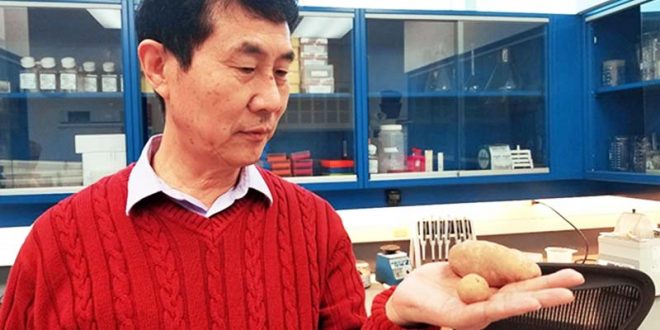
A study led by Dr. Xiu-Qing Li, a research scientist with Agriculture and Agri-Food Canada (AAFC) working at the Fredericton Research and Development Centre, Dr. Benoit Bizimungu, and scholars from Queen’s University was honored with the 2020 Outstanding Paper Award (given in 2021) from the American Journal of Potato Research.
Their study, “Effects of earliness on heat stress tolerance in fifty potato cultivars”, found that when grown under heat stress in greenhouses, potato cultivars known for maturing quickly in the field grew at rates comparable to later-maturing varieties, but the heat slowed down their maturation process.
The goal of Dr. Li and his team’s research was to identify the precise potato genes that may help explain why this is the case as well as the mechanisms that determine whether a potato variety will mature early or late.
“Heat stress causes potatoes to react by changing how long it takes them to mature – with more heat slowing down their growth. This creates a challenge for farmers in choosing which varieties to grow, determining when they can harvest, and knowing when they can expect to have products ready for market. More certainty about maturation rates could help them select the best variety to produce,” Dr. Xiu-Qing Li, Research Scientist, Agriculture, and Agri-Food Canada.
A New Research Project
Dr. Li launched and oversaw a new research project to learn even more following the publication of this prize-winning study, delving deeper into the genomic mechanisms underlying potato responses to heat stress. He discovered the genes that control heat-induced sprouting in 2020. Pre-harvest sprouting, also known as “heat sprouts” is a defect common in potatoes grown in hot, dry summers that can deplete nutrients, alter the chemical makeup, and lower a potato’s overall quality and marketability.
To determine whether the problematic sprouts were the result of just heat stress, 18 different varieties were used in this study. This study proved that heat alone was the problem and that the variety’s natural earliness or lateness had no effect on whether it sprouted in response to stress.
Researchers working with Dr. Li investigated the transcriptomic responses of heat-stressed potatoes to come to this conclusion. Transcriptomic studies provide an in-depth look into cell behavior and function by examining the genes, gene interaction networks, and mRNA features of a cell to see how they respond to environmental factors or diseases.
“Their study found that genes associated with dormancy reduced activity in heat-stressed potatoes, just as they did in potatoes that developed post-harvest heat sprouts, indicating that plant hormone metabolisms play a key role in heat sprouting. This information will prove useful when it comes to genetically improving potato varieties for tolerance to heat-sprouting,” according to a Canadian government press release.
“What we’ve found will be able to help farmers and processors make the best decisions about how to store and process their heat-stressed potatoes. This is a challenge facing producers around the world, and it has been very heartening to be able to contribute our understanding of the issue and to be able to make evidence-based recommendations,” Dr. Xiu-Qing Li, Research Scientist, Agriculture, and Agri-Food Canada said.
The research provided significant insights into choosing potato varieties for farming, the best methods for storing and using potatoes that have been exposed to heat stress, as well as the knowledge that will aid in the future development of heat-tolerant varieties.
Dr. Li suggests conducting more characterization of the varieties under hot summer conditions and continuing to develop integrated strategies in reducing the risk of heat stress because climate change threatens to bring still hotter, more erratic weather. Research of this kind is crucial to reducing the risk to potato production in Canada and elsewhere in the world.