

Researchers Transform Potato Chip Bags Into Cooling Films
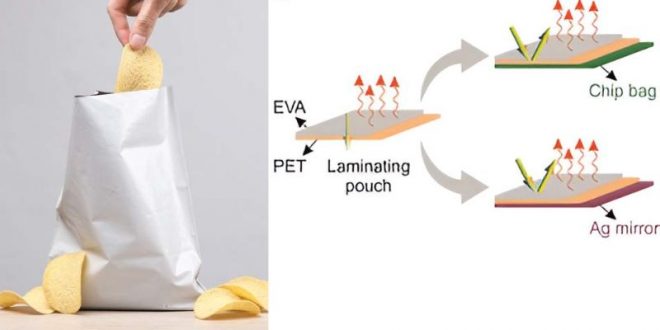
Dr. Qimeng Song and Prof. Dr. Markus Retsch have experimented with several methods to convert aluminum-plastic laminates (APL) packaging, like as potato chip bags, into effective cooling materials.
“Industrial processes that use polydimethylsiloxane (PDMS) as a coating material are possible. But as the recent study published in ACS Sustainable Chemistry & Engineering shows, it is also conceivable that the coating process could be undertaken by anybody in the future,” according to a recent science article.
APL films have been widely utilized for a long time to increase the shelf life of goods like chips. They were used to package FFP2 masks and quick tests during the COVID-19 pandemic.
The films, which are made of several polymer layers and an aluminum layer, shield the goods from potentially harmful elements like moisture, oxygen, sunshine, and heat. However, due to the combination of these many components, recycling such composite films is challenging.
The up-cycling process of chip bags now developed in Bayreuth shows a way to improve the recycling of APL waste and, at the same time, reduce global energy consumption. Cooling systems already account for around 15 % of global energy consumption, and given climate change and the occurrence of heat waves, this share threatens to continue to rise.
The aluminum layer of APL packaging provides a mirror-like reflective surface, such as that found on emergency blankets. If a clear polymer layer is now applied that increases the radiation of thermal energy, a powerful cooling system is complete. A simple laminating film, such as is commonly found in office supply stores, is already sufficient as a material for the coating.
The coating creates cooling foils that can be applied to any surface in the open air—such as umbrellas, blinds, and awnings—and thus prevent heating from glaring sunlight. At the same time, the ambient heat is diverted to the cool space without the need for an external energy supply. These effects are referred to as “passive daytime cooling”. Ideally, they can lead to temperatures below the ambient temperature, even in the case of intense sunlight.
Passive daytime cooling is made possible by the fact that the materials used meet special optical requirements. They must scatter or reflect as much of the sunlight as possible, which has a wavelength between 0.3 and 2.5 micrometers. On the other hand, in the wavelength range between 8 and 13 micrometers, the so-called sky window must emit as much thermal energy as possible into space in the form of infrared radiation.
Aluminum-plastic composite foils fulfill these requirements very well. Using the example of coated commercial potato chip bags, the Bayreuth researchers have demonstrated that around 87% of the sunlight is reflected by the aluminum layer. The additional polymer coating of the new sustainable cooling foils improves the radiation in the wavelength range of the sky window and thus emits heat directly into space.