

Latest MSU Potato Nutrient and Disease Management Discussion Topics
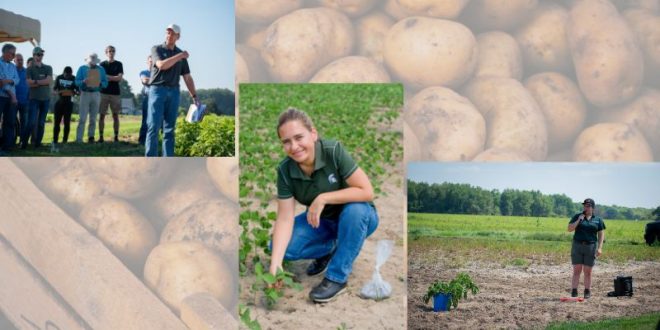
The main topics of discussion during Michigan State University Extension and MSU AgBioResearch’s field day on August 3 were potato nutrition and disease management.
The instructive meeting included talks among potato growers from across the state, workshops from MSU professors and research professionals, and a keynote lecture from Christopher Winslow, head of Ohio State University’s Sea Grant Program. It was hosted at the Montcalm Research Center of MSU AgBioResearch.
MSU presenters included Erin Burns, assistant professor of integrated weed management, Marisol Quintanilla, assistant professor of applied nematology, Kurt Steinke, associate professor of soil fertility and nutrient management, Zsofia Szendrei, associate professor of agroecology, Jaime Willbur, assistant professor of integrated disease management in potato and sugar beet production.
Grower advisers Casey Carr of Sackett Potatoes, Stephanie Kipp of Kipp Farm Services, the Michigan Potato Industry Commission, and additional agribusiness partners also lent their support in facilitating the event.
Phosphorous on Potato Farms
The need to apply and regulate phosphorus on potato farms was emphasized in Winslow’s lecture and was a recurring theme throughout the day. Although phosphorus is an essential mineral that helps plants absorb solar energy and grow roots, it can also have unfavorable effects by escaping from farms and affecting algae blooms in freshwater environments, such as the Western Lake Erie Basin.
To help mitigate phosphorous runoff, experts encouraged farmers to practice the “4Rs” of nutrient management: Right source of fertilizer nutrients, Right rate (amount) of fertilizer nutrients, Right time (of the year) to apply fertilizer nutrients, Right place (in the soil) to apply fertilizer nutrients.
In comparison to other field crops, Steinke talked about how the soil and plant features of potato cropping systems frequently result in lower phosphorus efficiency and higher phosphorus soil test values.
While there are ways to mitigate yield loss, such as banding phosphorus fertilizer before planting, the responsiveness of potatoes to phosphorus treatments still depends on the results of soil tests for phosphorus.
Phosphorus can attach itself to the soil’s surface or absorb itself within soil particles. By accumulating and exporting itself through field erosion, this phosphorus – also referred to as legacy phosphorus – may make its way into freshwater habitats.
Evaluating the transfer of legacy phosphorus into freshwater ecosystems requires taking into account several variables, including the phosphorus soil test value, the slope of a field, distance from a water source, conservation strategies, and the intensity and length of rainfall in a given location.
Applications of phosphorus that are not needed cost growers money and may pose a risk to the environment. Steinke advised farmers to do soil tests to determine which nutrients to apply and in what quantities.
“Soil sampling might not make (farmers) money, but it can save them money,” Steinke said, cited by MSU communicators in a recent press release.
Evaluate water management techniques as an additional approach to address phosphorous that is escaping. It is possible for soluble phosphorus to seep into freshwater through drainage water. The implementation of saturation buffers, which extract nutrients from drainage water, the planting of field buffers, such as trees and shrubs, which absorb nutrients before they reach bodies of freshwater, and the updating of drainage ditch systems are examples of mitigation techniques.
“Nutrient management and water management are difficult to separate or isolate because they each influence each other,” Steinke added.
The Michigan Department of Agriculture and Rural Development (MDARD) is supporting current research by MSU researchers looking at agricultural conservation techniques. Ehsan Ghane, an associate professor in MSU’s Department of Biosystems and Agricultural Engineering, is in charge of the initiative. She specializes in studying agricultural water management and water quality.
No Late Blight Detected in Michigan
Experts reported that late blight, a destructive foliar disease that affects tomato and potato crops, has not yet been found in Michigan this year.
To find any indications of late blight, Willbur said she has been collaborating with the MSU Potato Outreach Program, MSU Extension, and the Michigan potato industry to analyze the aerial spores – those discharged from the plant above ground – from potato harvests. Currently, sampling is being conducted in three counties, one of which is Montcalm County, where potato late blight was discovered the previous year rather than this year.
Funding for the initiative comes from the Michigan Potato Industry Commission and initiative GREEEN, a collaboration in plant agriculture between MDARD, MSU AgBioResearch, and MSU Extension, as well as plant-based commodities groupings.
The tiny spores are collected using battery-operated spinning rods coated in a sticky substance like vaseline, according to Steve Whittington, an MSU Extension field crops instructor.
Every week, Whittington collects the rods scattered over Montcalm County, and an MSU technician examines them to check for late blight spores. Farmers can prevent and manage crop outbreaks with early notice if late blight is found on the rods.
The samplers were deployed in June this year. Whittington said he hopes that as this project progresses, it will be replicated to assist potato farmers statewide.
“We’ve got a couple of big potato farmers in the region, and we work with all their agronomists to identify where the most strategic areas are to place these samplers. This project has been effective because it’s given us another tool to monitor a potential disease that could affect these crops,” Whittington mentioned.
Examining Potato Early Die Complex
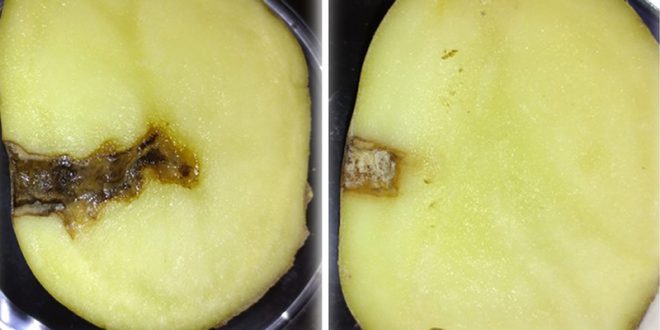
Apart from the studies on late blight, Quintanilla also presented studies on early die complex in potatoes. The devastating disease is brought on by an attack on the root system by the root-lesion worm Pratylenchus penetrans and the soilborne fungus Verticillium dahliae.
The National Institute of Food and Agriculture of the U.S. Department of Agriculture awarded USD750,000 funding to Quintanilla’s research team earlier this year to assess and create sustainable approaches to managing the potato early die problem.
Fumigation is one of the current disease-fighting techniques, although it can harm the soil’s microbiome. According to research done by Quintanilla and her colleagues – doctoral candidate Luisa Parrado and graduate student Abigail Palmisano – poultry manure and a combination of compost are useful in fighting germs.
The researchers experimented with two therapy blends before receiving the money, and they will be employed in future studies. Two more compost and manure blends, however, have been discovered since the grant’s announcement and will be incorporated into the research.
The following two years will be dedicated to conducting experiments. Researchers and extension agents will share the findings throughout the third year. Next spring, information from the first growing season of this year – which will take place at two distinct potato farms in Michigan – will be gathered.