

UI Extension’s National Chip Processing Trials
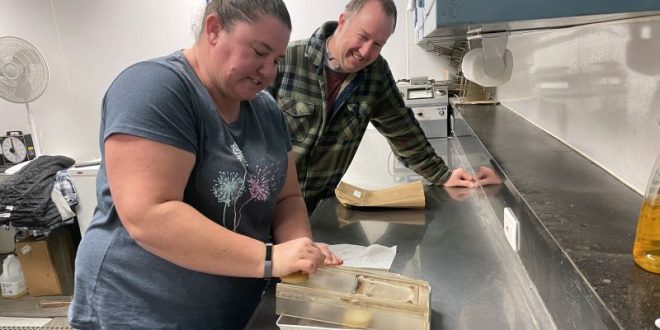
Chelsey Lowder, a research assistant, cut a white-fleshed, tennis ball-sized tuber into transparent circles at the University of Idaho’s Aberdeen Research and Extension Center basement kitchen. She then let the circles dry before placing them in a fryer.
Lowder took the basket out once the hot oil had stopped boiling and arranged the finished chips next to a color wheel in a row. Rhett Spear, a potato variety development specialist with UI Extension, explained that although the chips were a little dark, they were still within the approved color range for the industry.
The scientists of the U of I and USDA-Agricultural Research Service collaborative potato breeding program based in Aberdeen frequently fry snack dishes for meticulous evaluation. The team spends the majority of its work creating russet potatoes for generating French fries, but there are also consistently growing quantities of potatoes for chipping in the pipeline.
On March 14, which is the U.S.’s National Potato Chip Day, the University of Idaho significantly contributes to packing bags with the nation’s favorite snack food.
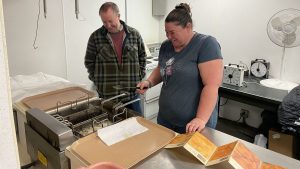 The National Chip Processing Trials is a countrywide initiative to find the next great varieties for creating chips, and Aberdeen is one of a dozen public potato breeding programs around the U.S. that participates in it. The University of Florida will shortly be included in the trials as the 13th program.
Chippers make up, according to Rich Novy, a USDA-ARS potato producer, 10-15% of his breeding crosses. Spear is responsible for the laborious evaluation process for the breeding program’s potatoes.
“Chips, in general, are made from potatoes with a high specific gravity which gives a better chip texture. They want a round potato, and usually, it’s a white-fleshed potato. We’re looking for a high tuber set and tuber size somewhere between a racquetball and a baseball,” Spear said.
Novy creates a cross in a greenhouse to begin the variety development process. Even though the potato industry uses clonal propagation, breeders collect real potato seeds from berries and plants and germinate them in a greenhouse to produce seedling tubers.
Choosing the Best Potato Specimens From the Plots of Chippers
The process of creating a new chipping potato variety begins when those seedling tubers are planted in the field the next growing season and chipping clones are chosen for improved agronomics. The best specimens are chosen from the plots of chippers raised in Aberdeen with the assistance of researchers and industry professionals, including R & G Potato Co. in American Falls and Walther Farms in Michigan.
The Tri-State Potato Breeding Program in the Pacific Northwest brings together the potato breeding programs from the University of Idaho, the USDA Agricultural Research Service, Washington State University, and Oregon State University. The Potato Variety Management Institute, a non-profit organization, manages Tri-State varieties’ licensing and royalties.
The best crosses proceed to the Tri-State Trials and are grown there after many field generations in Aberdeen. The top kinds from those trials advance to the Western Regional Trials, which also take place in Texas, Colorado, and California.
The National Chip Processing Trials are organized by Potatoes USA and feature hundreds of entries. Each participating program evaluates the entries based on around 20 different factors, including yield, quality, storage qualities, and fry color.
“Those candidates are in the system for five or six years, and after about year four, a handful that looks good go into our SNAC (Snacking, Nutrition, and Convenience) Trials. In the first year of the National Chip program, you’re looking at 17 hills. That’s like one row of potatoes. By the time you get to the SNAC Trials, we are committing a third of an acre – that’s what they need to run through a chip plant to see how they process,” John Lundeen, research director with Potatoes USA mentioned.
Before an annual gathering in Chicago in early December, where researchers and industry gather to discuss the findings, the trials close.
“You go from tens of thousands down to just a handful in final testing, and not even all in that handful get commercially released,” Lundeen added.
Three chipping types were released by the Tri-State program throughout its existence: Gem Chip in 1989, Ivory Crisp in 2002, and Willamette in 2003. Ivory Crisp, the most widely used variety, was first chosen and created as part of the Aberdeen program before being made available as a Tri-State potato variety.
Novy created the first cross between A13125-3C and another promising Aberdeen breeding line. Pathogen-free tissue culture plantlets are being created at a facility at Michigan State University to produce certified seed for the National Chip Program’s more thorough evaluations of that line.
“Potato chips are the greatest snack. Just think of how many sandwich restaurants you go into where there’s a whole display of chips, and think how many kids’ lunch bags have a small bag of chips in them. They’re an essential product that the American people love,” Lundeen concluded.