

Agriculture Ministers agreed to strengthen EU policies for young farmers
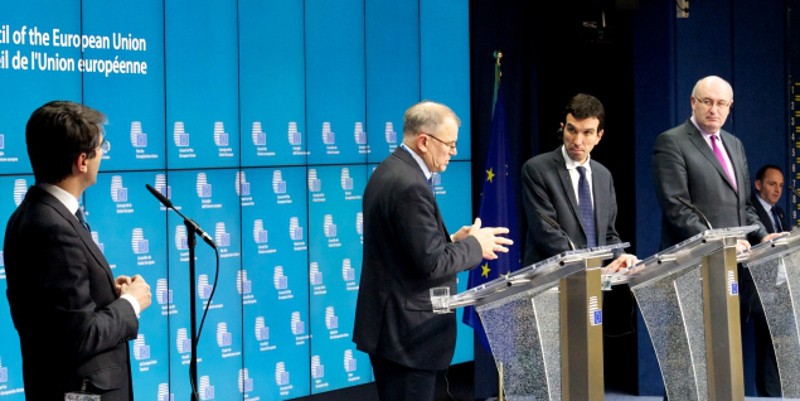
Agriculture Ministers from across the EU agreed on Presidency Conclusions in order to promote generational renewal in the sector.
At the Agriculture and Fisheries Council meeting in Brussels, December 15, a large number of member states supported Presidency conclusions on strengthening the EU policies for young farmers exploring possible solutions complementing the CAP (common agricultural policy) tools in favor of young farmers to reduce the existing barriers to enter in the sector, is explained in a press release from the institution.
The Presidency of the Council of the European Union considers that young farmers and generational renewal in agriculture are fundamental for the sustainability and long term competitiveness of European agriculture.
The institution notes with concern that youth unemployment rate is over 23 per cent, it means more than 5 million of young people are unemployed in the EU-28 area.
The Presidency notes with concern that the proportion of EU farmers under 35 is only 7.5 per cent of the farming population, compared with more than 30 per cent over the age of 65.
The Agriculture Ministers are aware that generational renewal in agriculture is a precondition for maintaining viable food production and improving the competitiveness of the sector.
“New entrants are needed to take over from retiring farmers, to invest and modernize their agricultural holdings. However, in a situation where good agricultural land is scarce, they depend also on the transfer of land from already existing farms. Young farmers also need support for initial investments, access to loans, land, business advice and training to become more modern and competitive”, explains the official document.
On the other hand, the Presidency recognizes that the recently approved CAP 2014-2020 contains significant measures supporting young farmers both in the first and second pillar, and it is important to implement these measures in an effective manner.
The institutions recognizes that despite the recently adopted CAP measures, young entrepreneurs in agriculture still have to overcome significant barriers of economic, social and market nature, to enter the sector.
Another conclusion is that the institution considers that, in order to fully unleash the potential of young farming and generational renewal, it is fundamental to overcome these barriers. In particular in terms of access to credit, land and transfer of innovation and professional experience.
The Presidency of the Council of the European Union welcomes the “Memorandum of Understanding for co-operation in agriculture and rural development” signed by the European Commission and the European Investment Bank (EIB) in July 2014. The strategic implementation of this agreement could provide tangible outcomes in terms of creating jobs and favoring growth in the sector, in line with the Europe 2020 Strategy and the new Commission’s priorities for agriculture.
The institution invites the European Commission and the EIB to enforce all the available tools, in particular under the EU rural development policy and including those to be developed under the “Memorandum of Understanding for co-operation in agriculture and rural development”, jointly with Member States, to provide favourable support conditions to young farmers who just started or who are starting a business in the agricultural sector such as financial instruments and appropriate lending possibilities.
The 10th conclusion is that the Presidency acknowledges that land is the main factor of production in agriculture and that securing access to farmland is fundamental at a time when a whole generation of European farmers is reaching retirement age. Any measure to facilitate access to land should be implemented in a way to avoid speculation on land market price, sais the document.
The institution emphasizes that it should be possible for Member States, on a voluntary basis, to provide zero interest rate loans for land acquisition to young farmers that possess adequate occupational skills and submit a business plan, in line with Regulation No 1305/2013.
The Presidency of EC considers that in order to facilitate knowledge transfer and innovation, as well as the exchange of information and professional experiences in the EU, it could be useful to envisage programs similar to the “Erasmus” project, that young farmers could benefit from for a short period of time thanks to the support of the national and European rural networks.
The institution invites the European Commission to develop and provide guidelines to establish such exchange of experience in the context of the rural networks and Member States’ rural development programs.
The Presidency of the Council of the European Union invites the European Commission to consider the particular effects on young farmers when preparing new legislative initiatives in order to stimulate the generational renewal in agriculture.
CEJA hails Presidency conclusions
The European Council of Young Farmers (CEJA) considers the Presidency Conclusions outline and recognize the current demographic situation in the EU farming population as a matter of serious concern which needs to be addressed.
The document also acknowledges the lack of access to credit as a huge barrier to young people attempting to start, or take over, a farm and addresses the problem by calling upon the European Investment Bank (EIB) to facilitate loans at favorable rates exclusively to young farmers.
Addressing CEJA members alongside Minister Martina at the CEJA working group after the Council meeting, CEJA President Matteo Bartolini strongly welcomed the conclusions, saying:
“CEJA is delighted to see that young farmers are at the heart of these Presidency conclusions. It is excellent news that the EU farm Ministers have been able to agree on plans for support to be made available to young people attempting to access the sector in the coming years. If these are implemented successfully, we may be able to eradicate one of the biggest barriers to entry of the sector, thereby enabling young farmers to improve the job creation, growth and competitiveness of European agriculture.”
Photo: http://tvnewsroom.consilium.europa.eu/
From left to right: Vytenis Pavilas Andriukaitis, Member of the European Commission; Maurizio Martina, Italian Minister for Agriculture, Food and Forestry Policy; Phil Hogan, Member of the European Commission.
Related articles:
Euro-Med Ministerial Conference on Agriculture calls for political focus on young farmers
A guarantee fund for young farmers at EU level? 28 EU ministers for agriculture addressed by CEJA
CEJA announced new partnership with Bekina to help young farmers